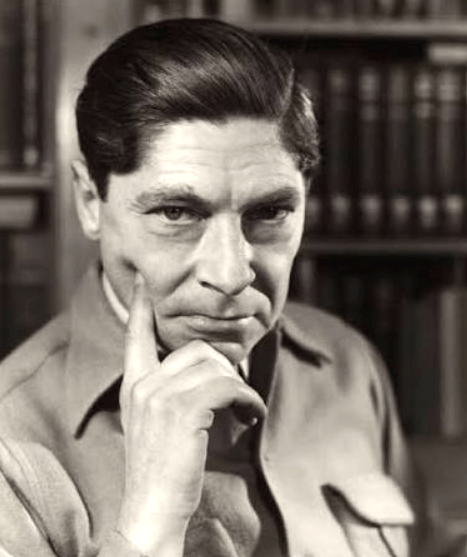
Arthur Koestler (1905–1983) was a Hungarian-born British writer, journalist and essayist whose work ranged across politics, psychology, science and philosophy. Internationally known for Darkness at Noon, he later became increasingly interested in the organization of living systems, human cognition and the evolutionary foundations of human behaviour.
The View of Arthur Koestler
Adapted from The Limits of Intelligence
From the end of the 1950s onward, after the major phase of his career as a novelist and political writer, Arthur Koestler increasingly turned his attention to evolution, creativity, human intelligence and what he came to regard as the pathology of the human mind.
What makes Koestler particularly relevant to Cancerism is that he did not simply criticize the misuse of intelligence. He increasingly suspected that something might have gone wrong in the evolutionary construction of the human brain itself.
One of his most suggestive formulations appears in The Ghost in the Machine (1967), where he describes what he calls “the paradox of the unsolicited gift.”
Koestler illustrates the idea with a parable. An illiterate shopkeeper asks for a simple calculating device that might help him in his business. Instead, by some cosmic administrative error, he receives an immensely sophisticated computer that he neither requested nor knows how to operate.
The meaning of the parable is clear. Evolution endowed Homo sapiens with an extraordinarily powerful brain, but without providing an adequate “instruction manual” for its use.
From the perspective of Cancerism, this “unsolicited gift” corresponds closely to what I have called the abnormal development of the human brain.
The human brain was not bestowed upon us by some supernatural intelligence. It arose from the same evolutionary processes that produced every other biological structure. But evolution is not a rational engineer working toward a predetermined goal. It proceeds through variation, selection, trial and error.
Koestler himself repeatedly insisted on this point.
In The Ghost in the Machine he argues that evolution, like any other strategy based on experimentation, is capable of mistakes. Human beings may therefore possess an evolutionary endowment superior in certain respects to that of every other known species while at the same time carrying within themselves a defect capable of predisposing them to self-destruction.
This idea had already appeared, in embryonic form, in his earlier works.
In The Sleepwalkers (1959), devoted to the intellectual revolution associated with Copernicus, Kepler, Galileo and Newton, Koestler remarks that mental evolution, like biological evolution, can contain “faulty junctions” and harmful connections.
In The Act of Creation (1964), he examines the mechanisms through which the mind produces novelty and discovery. Creativity itself emerges from combinations and collisions between previously separate systems of thought.
But in The Ghost in the Machine the problem becomes explicitly biological.
Koestler asks whether the extraordinary success of Homo sapiens may conceal an evolutionary defect.
The Unsolicited Gift
The striking feature of human evolution is not simply the size of the brain.
Neanderthals possessed brains comparable in volume, and in some cases slightly larger, than those of modern humans. What distinguishes Homo sapiens cannot therefore be reduced to cranial capacity alone.
Organization, connectivity, development and the relationship among different cerebral systems are at least as important as absolute volume.
What matters for the present argument is that the evolutionary development of the human brain gave our species unprecedented capacities for abstraction, planning, symbolic communication, technological innovation and cumulative culture.
Those capacities gradually changed the relationship between one animal species and the rest of the biosphere.
At first the change was slow.
Later it accelerated.
The same organ that permitted language, science, art and foresight also made possible agriculture, large-scale warfare, industrialization, fossil-energy exploitation, planetary communications and the systematic transformation of ecosystems.
The “unsolicited gift” eventually became the most powerful instrument ever produced by biological evolution on Earth.
But power is not the same thing as control.
An Evolutionary Error?
Koestler took seriously the possibility that the rapid development of the human brain might have produced a structural imbalance.
He refers to the extraordinary speed of cerebral evolution as something almost unique in the history of life and asks whether the result might contain a defect.
At one point he reports a striking comparison attributed to the neurologist Charles Judson Herrick: the human cortex could be regarded as “a kind of tumorous growth” whose functions have expanded beyond normal control.
This is particularly interesting from the perspective of Cancerism.
Koestler does not say that Homo sapiens is a cancer cell within the organism of the Earth.
The analogy is different.
The pathological comparison concerns the brain itself: the cerebral cortex may have undergone a disproportionately rapid expansion, somewhat analogous to a biological structure whose growth escapes ordinary regulation.
Koestler does not ultimately attribute the problem simply to cortical size. His central concern becomes the insufficient coordination between the phylogenetically older structures of the brain and the more recently developed neocortex.
In other words, evolution may have superimposed an extraordinarily powerful new cognitive system upon much older emotional and instinctive structures without integrating the two adequately.
The result would be an organism capable of extraordinary intellectual achievements but still driven by ancient impulses originally adapted to very different ecological conditions.
From this perspective, the problem is not intelligence alone.
The problem is the combination of immense cognitive power with motivational systems inherited from a much older evolutionary past.
A Manufacturing Defect
Koestler eventually asks whether humanity might carry what he calls a “manufacturing defect” inside the skull: an evolutionary construction error potentially capable of threatening the survival of the species.
This formulation brings him remarkably close to one of the central hypotheses of Cancerism.
Cancerism argues that the ecological malignancy of Homo sapiens cannot be understood simply by condemning greed, capitalism, technology, Western civilization or any particular historical system.
Those are manifestations of a deeper phenomenon.
The decisive change occurred when one species acquired a command organ capable of amplifying its natural drive for survival, expansion and resource acquisition to a degree unmatched by any other living organism.
The ordinary biological impulses of an animal were combined with an extraordinary capacity to invent tools, transmit knowledge, reorganize environments and progressively escape ecological limitations.
Koestler’s analysis points toward the same underlying problem, although he develops it in a different direction.
The Old Brain and the New
According to Koestler, the evolutionary problem lies particularly in the insufficient coordination between the older and newer regions of the brain.
The ancient structures associated with instinct and emotion did not disappear when the neocortex evolved.
They remained active.
The new brain added unprecedented capacities for abstraction, calculation and technological innovation, but it did not necessarily acquire complete control over the older motivational systems.
The result is a creature capable of using reason in the service of impulses that reason itself did not create.
Intelligence becomes an amplifier.
Aggression can become organized warfare.
Territoriality can become empire.
Resource acquisition can become global industrial extraction.
Competition can become technological and economic domination.
Fear can become weapons capable of exterminating entire populations.
The peculiar tragedy of Homo sapiens is therefore that the most sophisticated cognitive machinery ever produced by evolution can be placed at the service of behavioural tendencies that originated long before anything resembling civilization existed.
For Koestler, this mismatch helps explain the recurrent irrationality of human history.
For Cancerism, the same mismatch contributes to explaining why human intelligence became the principal instrument through which one species progressively destabilized the biosphere.
Koestler’s Proposed Cure
Here, however, Koestler and Cancerism begin to diverge.
Koestler never abandons the hope that the evolutionary defect can be corrected.
If the problem is biological, he reasons, perhaps the solution must also be biological.
Since spontaneous evolution cannot be expected to redesign the human brain within a historically useful timescale, Koestler speculates about artificial means of improving coordination among its conflicting systems.
He therefore places some hope in biochemistry and psychopharmacology.
Medicine, in his view, might one day be capable of reducing the pathological conflict between the older emotional brain and the newer rational structures.
He does not imagine the insertion of new cerebral circuits in the technological sense familiar to us today. Instead, he wonders whether chemical intervention might improve coordination among the circuits already present.
This proposal must be understood in the context of the 1960s.
Koestler was writing long before contemporary research on brain–computer interfaces, neural implants and artificial intelligence had transformed the technological horizon.
What matters here is not whether his proposed remedy was plausible.
What matters is that he regarded the human predicament as sufficiently deep to require intervention at the level of the biological organ responsible for human behaviour.
He did not believe that moral exhortation alone would solve the problem.
Humanity, in his view, had been exposed to religious and ethical persuasion for millennia without overcoming war, hatred and collective irrationality.
The Janus Principle
Koestler returned to these themes in his later works.
In The Roots of Coincidence (1972), although his attention turned toward subjects such as paranormal phenomena and quantum physics, the underlying concern remained the same: the limitations and possible inadequacies of the human cognitive apparatus.
His final synthesis appeared in Janus: A Summing Up (1978).
Koestler himself described the book as a continuation and summary of the work he had pursued for roughly twenty-five years after moving away from fiction and political writing toward evolution, creativity and the pathology of the human mind.
Again he identifies the central difficulty in the explosive development of the human neocortex and its insufficient capacity to control older cerebral systems.
Again he searches for a corrective.
If medicine can alter certain pathological mental conditions, he suggests, it might eventually become possible to modify the biological mechanisms underlying humanity’s destructive tendencies.
The Point of Divergence
This is where Cancerism parts company with Koestler.
Koestler diagnoses an evolutionary problem with extraordinary clarity, but his ultimate objective remains the salvation and improved functioning of Homo sapiens.
He wants a better-integrated human brain.
He hopes that reason can gain more effective control over instinct.
Cancerism asks a different question.
Even if Homo sapiens became less internally violent, would that necessarily restore the ecological balance of the biosphere?
A more rational, peaceful and efficiently organized humanity could theoretically continue to consume enormous quantities of resources, transform landscapes, eliminate other species and extend technological control over the planet.
The problem may therefore be broader than the conflict between the old brain and the new.
From the perspective of Cancerism, the decisive evolutionary anomaly is that the human brain gave one species the capacity to escape the regulatory constraints that normally prevent any single population from dominating the entire living system.
Human intelligence did not merely create internal psychological instability.
It created ecological power without precedent.
From Intelligence to Planetary Power
Koestler understood perfectly well that scientific intelligence had produced powers capable of threatening humanity itself.
He identified August 6, 1945 — the destruction of Hiroshima — as a decisive date in human history.
Before that day, he argued, individual human beings had always lived with the knowledge of personal mortality.
After Hiroshima, humanity had to live with the possibility of extinction as a species.
This observation is fundamental.
But Cancerism extends the argument further.
The destructive consequences of abnormal cerebral development are not limited to nuclear weapons or to the possibility of human self-extermination.
The same cognitive power that created atomic weapons has transformed forests, rivers, oceans, climates, animal populations and biogeochemical cycles.
The danger is not simply that Homo sapiens may destroy itself.
It is that one species has become capable of disrupting the biological system of which it is only one component.
In this sense, the evolutionary anomaly identified by Koestler acquires a further significance.
The abnormal development of the human command organ transformed a biologically ordinary animal into a planetary force.
What had been an adaptive advantage became a mechanism of domination.
What had enabled survival became capable of undermining the conditions of life itself.
The Artificial Human World
Koestler was also aware that humanity had become dependent upon the artificial environment it had created.
From the earliest use of clothing and tools onward, human beings progressively constructed a technological layer between themselves and the natural world.
That process eventually became irreversible.
Modern humanity cannot simply abandon agriculture, medicine, cities, energy systems, transportation and technology and return to an imagined original state.
Koestler therefore concluded that the human organism itself had to be adapted to the artificial world it had created.
Cancerism reaches a more pessimistic conclusion.
If the artificial environment is itself one of the products of abnormal cerebral development, modifying the brain merely to make humanity function more efficiently within that environment may stabilize the pathological process rather than reverse it.
A malignant system can become more efficient without becoming healthy.
This is the essential difference.
Koestler asks how the human brain might be repaired so that Homo sapiens can survive.
Cancerism asks whether the very evolutionary process that gave Homo sapiens planetary dominance has transformed our species into a destructive component of the biosphere.
Koestler as a Precursor of Cancerism
Arthur Koestler never formulated Cancerism.
Nor did he systematically describe humanity as a malignant cell within the living system of the Earth.
Nevertheless, few twentieth-century thinkers came so close to identifying what Cancerism regards as one of the deepest causes of the human ecological crisis.
Koestler understood that evolution can make mistakes.
He suspected that the human brain might contain such an error.
He connected the extraordinary rapidity of cerebral development with the instability of human behaviour.
He described humanity as potentially carrying a biological defect capable of causing its own destruction.
He even transmitted an explicit analogy between abnormal cortical growth and tumorous development.
Most importantly, he refused to treat human intelligence as an unquestionable evolutionary triumph.
For Koestler, the “glory of man” was also a possible source of pathology.
Cancerism takes this intuition one step further.
The abnormal development of the human brain did not merely make Homo sapiens psychologically unstable or potentially self-destructive.
It provided the cognitive instrument through which one species acquired the power to overcome ecological limits, dominate other forms of life and progressively transform the biosphere in ways structurally comparable to malignant growth.
In this respect, Arthur Koestler occupies an important place among the precursors and contributors to Cancerism.
KEY AFFINITIES WITH CANCERISM
- Evolution as a process of trial and error
- Human intelligence as an “unsolicited gift”
- Exceptionally rapid development of the human brain
- The possibility of an evolutionary “manufacturing defect”
- Insufficient integration between older brain structures and the neocortex
- Cerebral development compared with pathological or tumorous growth
- Intelligence as a potentially self-destructive evolutionary trait
- Technology as an amplification of human biological drives
- The possibility that the organ responsible for human supremacy is also the source of human pathology
WORKS DISCUSSED
Arthur Koestler, The Sleepwalkers: A History of Man’s Changing Vision of the Universe (1959).
Arthur Koestler, The Act of Creation (1964).
Arthur Koestler, The Ghost in the Machine (1967).
Arthur Koestler, The Roots of Coincidence (1972).
Arthur Koestler, Janus: A Summing Up (1978).
