Cancerism – Home

CANCERISM

Why Humanity Is Earth’s Malignancy

Human civilization has transformed the Earth on a scale unprecedented in the history of life. Cancerism proposes a radical interpretation of this transformation: humanity’s population growth, territorial expansion, resource consumption, and destruction of biodiversity display striking structural similarities to the behavior of a malignant tumor within a living organism.

What Is Cancerism?

Cancerism is an interpretive framework for understanding humanity’s relationship with the biosphere.

A malignant tumor is not an external enemy attacking an organism. It arises from the organism itself, when some of its own cells cease to respect the regulatory mechanisms that make the life of the whole possible. They proliferate, appropriate resources, invade surrounding tissues, spread into new territories, and ultimately threaten the system upon which their own existence depends.

Humanity has followed a disturbingly similar trajectory. One species among millions has escaped many of the ecological constraints that once regulated its numbers and behavior. It has multiplied exponentially, appropriated an ever-growing share of the planet’s resources, transformed ecosystems, displaced other species, and progressively extended its presence across the entire biosphere.

Cancerism asks a simple but unsettling question:

What if the ecological crisis is not merely the result of human mistakes, but the consequence of the very evolutionary characteristics that made our extraordinary expansion possible?

The Biological Parallel

Cancerism examines a series of structural correspondences between malignant growth and the historical expansion of human civilization.

Uncontrolled Growth

Cancer cells escape the mechanisms that normally regulate cellular proliferation. Human population and economic activity likewise underwent extraordinary growth once technological development weakened many of the natural constraints that had previously limited them.

Resource Appropriation

Tumors redirect nutrients and energy toward their own expansion. Human civilization increasingly appropriates land, water, biomass, minerals, and energy from the ecosystems on which all terrestrial life depends.

Invasion

Malignant cells invade neighboring tissues. Human communities have progressively occupied and transformed virtually every terrestrial environment accessible to them.

Dissemination

Cancer spreads from its original site to distant parts of the organism. Humanity originated in a geographically restricted area and eventually colonized the entire planet.

Loss of Diversity

The expansion of a tumor replaces differentiated, functional tissues with proliferating malignant cells. Human expansion similarly tends to replace complex ecosystems with increasingly homogeneous environments designed around the requirements of a single species.

Dependence on the Host

A tumor cannot survive without the organism it exploits. Humanity cannot survive independently of the biosphere whose stability it is progressively undermining.

The Evolutionary Paradox

The history of our species is usually told as a history of progress.

The human brain produced language, abstract thought, technology, agriculture, cities, science, industry, and eventually a civilization capable of altering the functioning of the entire planet.

Cancerism examines the other side of that extraordinary evolutionary success. The same intelligence that enabled Homo sapiens to overcome many environmental constraints also gave the species an unprecedented capacity to expand beyond them.

The organ that made humanity the most powerful species on Earth may also have enabled behaviors that threaten the conditions necessary for its survival.

Seven Books. One Theory.

Cancerism developed through seven books exploring the same central problem from biological, evolutionary, historical, anthropological, sociological, philosophical, and political perspectives. Together they trace the trajectory from the emergence of the human anomaly to the planetary civilization now confronting the consequences of its own expansion.

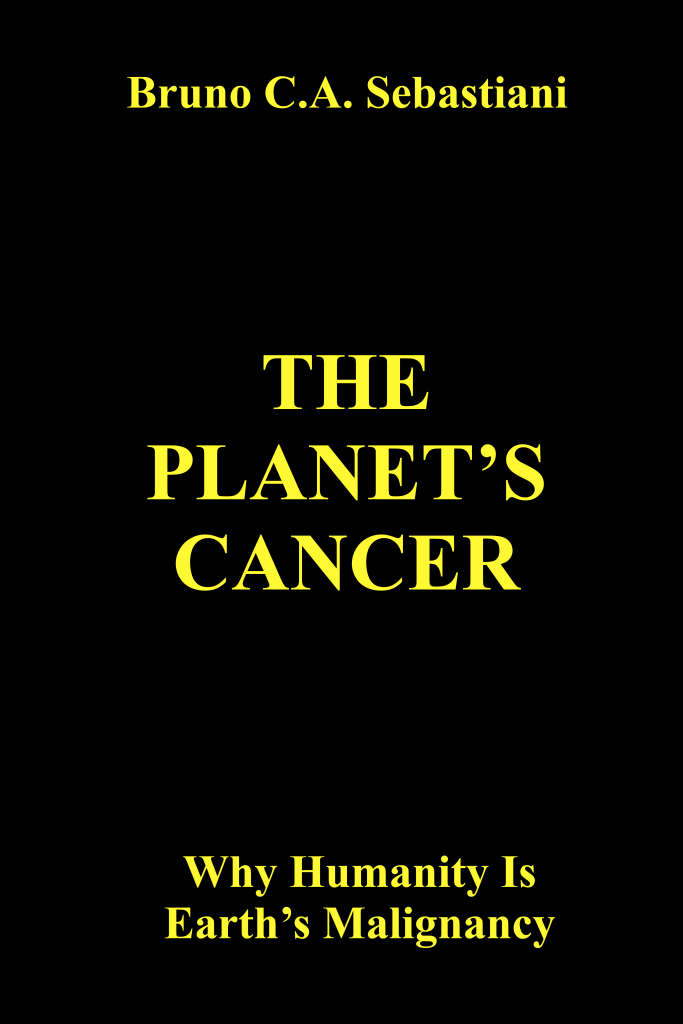
Cover of The Planet’s Cancer by Bruno Cesare Antonio Sebastiani

The Planet’s Cancer

Why Humanity Is Earth’s Malignancy

The foundation of Cancerism: an examination of the structural similarities between the expansion of humanity within the biosphere and the behavior of malignant cells within a living organism.

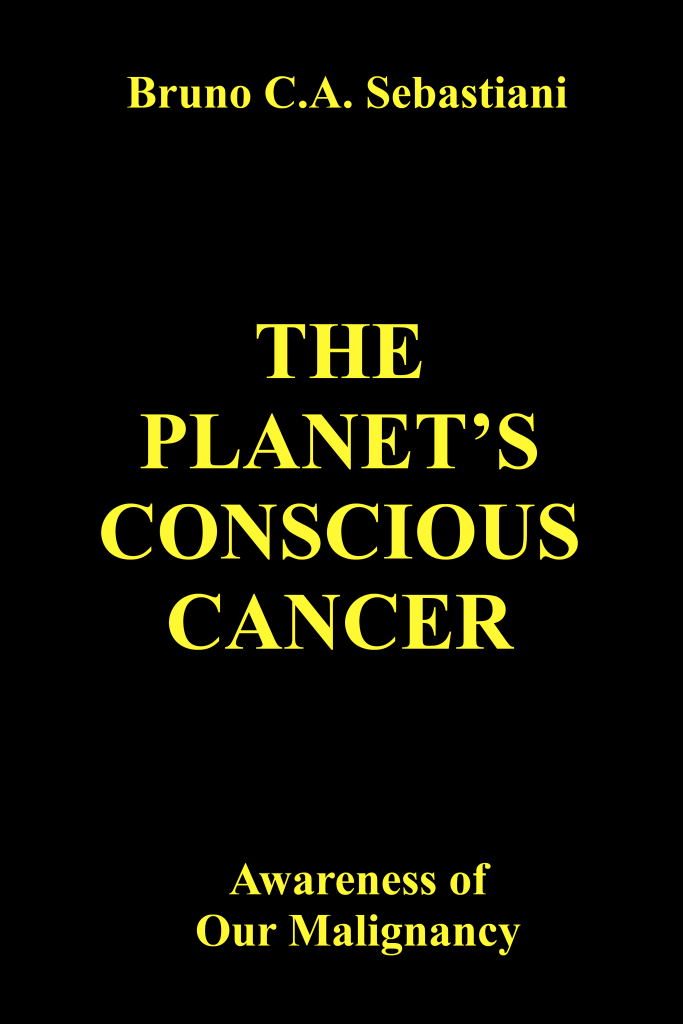
The Planet’s Conscious Cancer

Awareness of Our Malignancy

The emergence of consciousness introduces a new paradox: humanity becomes capable of understanding the consequences of its expansion while remaining unable—or unwilling—to abandon the processes that drive it.

Cover of The Planet’s Conscious Cancer by Bruno Cesare Antonio Sebastiani
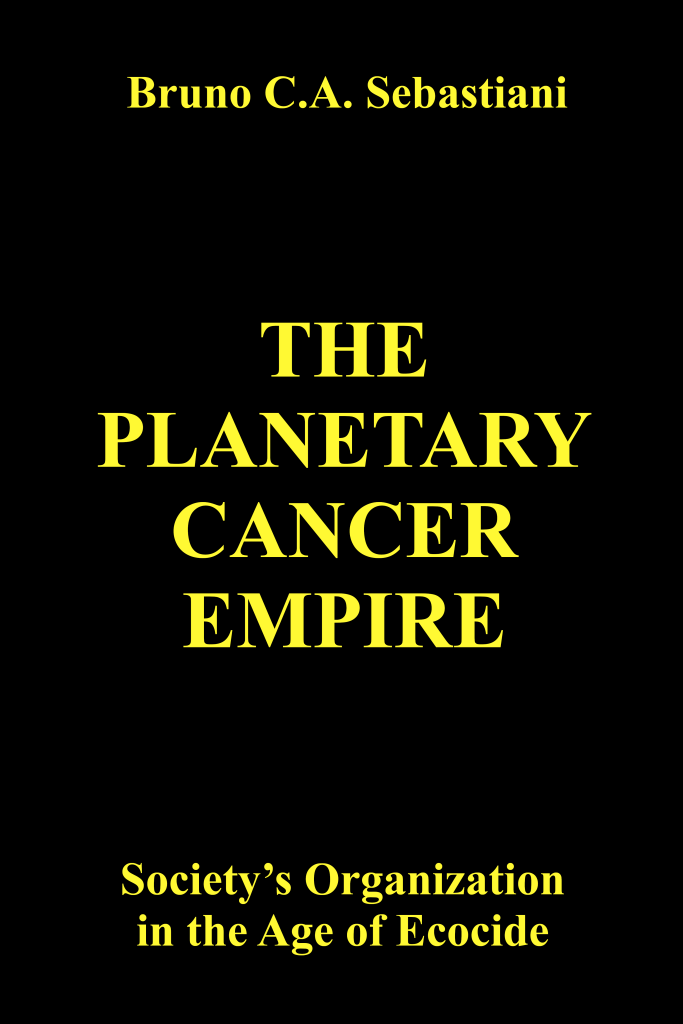
Cover of The Planetay Cancer Empire by Bruno Cesare Antonio Sebastiani

The Planetary Cancer Empire

Society’s Organization in the Age of Ecocide

Cancerism expands from the biological analogy to the global structures created by human civilization, examining how technological, economic, and political systems have transformed humanity’s expansion into a planetary process.

Revelation

Address to the Malignant Cells

A direct address to humanity as the conscious component of the planetary malignancy, confronting the species with the consequences of its expansion and with the possibility — and difficulty — of recognizing its own condition.

Cover of Revelation by Bruno Cesare Antonio Sebastiani
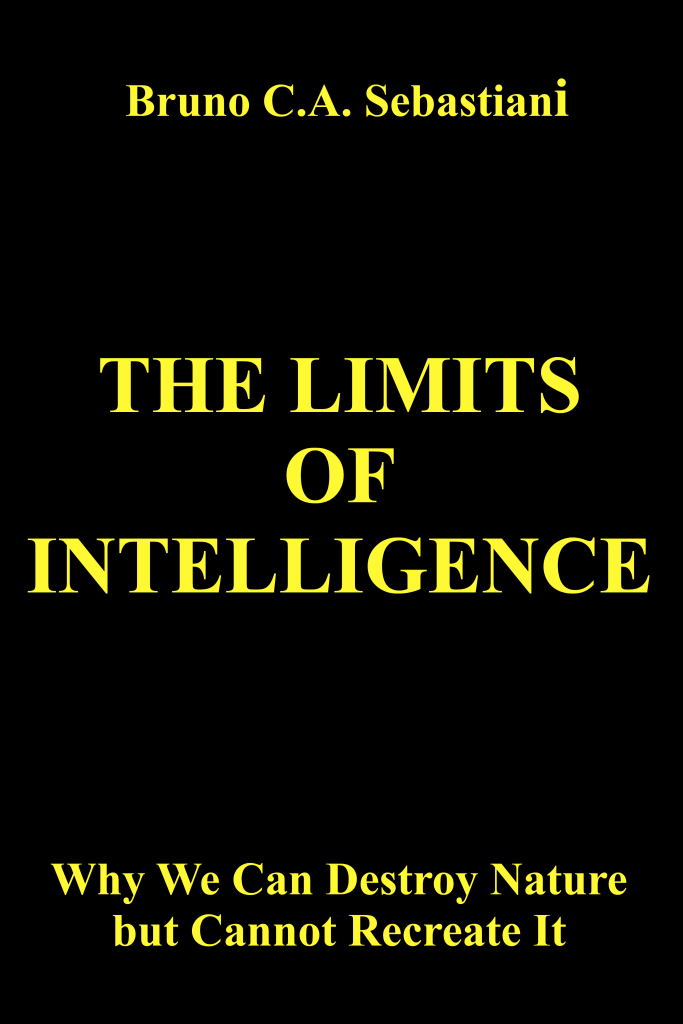
Cover of The Limits of Intelligence by Bruno Cesare Antonio Sebastiani

The Limits of Intelligence

Why We Can Destroy Nature but Cannot Recreate It

An examination of the paradoxical limits of human intelligence: powerful enough to transform and destroy extraordinarily complex natural systems, yet incapable of recreating the processes and relationships that produced them.

P.I. Personal Index

Parliamentary Chronicles from the Future

An independent work of speculative political satire set in a future world governed through a universal Personal Index: a numerical Score that classifies every citizen and determines status, responsibility, employment, and privilege.

Cover of P.I. Personal Index by Bruno Cesare Antonio Sebastiani
Cover of Heretical Thoughts by Bruno Cesare Antonio Sebastiani

Heretical Thoughts

Short Essays Against Progressive Orthodoxy

A concluding collection of short essays challenging the faith in human intelligence, scientific and technological progress, and anthropocentric assumptions that Cancerism identifies as central to the ecological crisis.