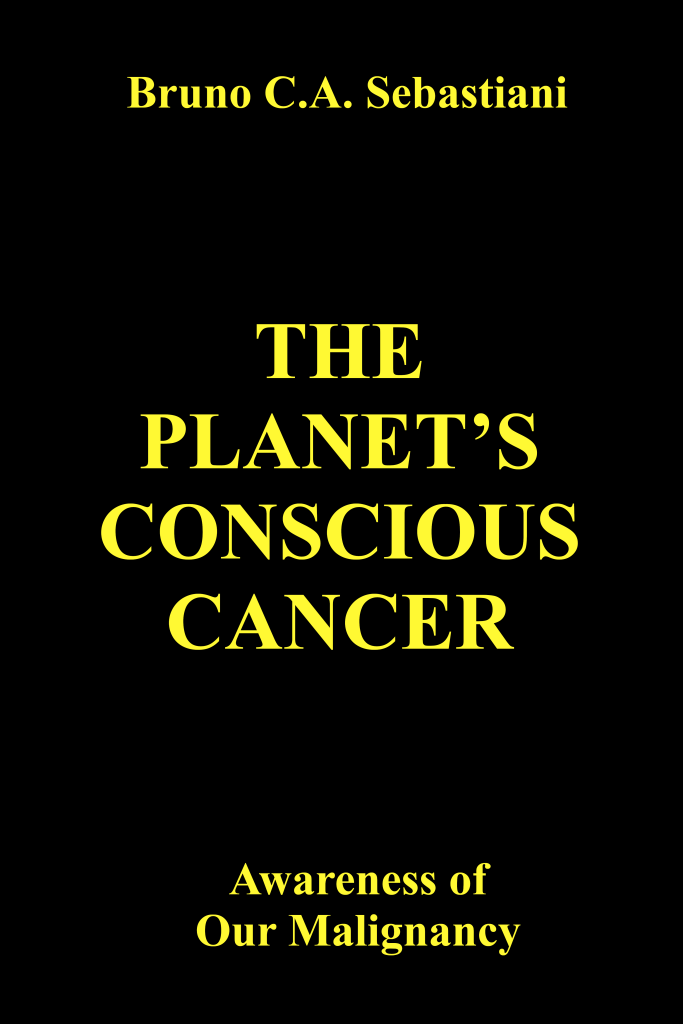
Awareness of Our Malignancy
The Planet’s Conscious Cancer develops the next stage of Cancerism: the emergence of awareness within a species whose expansion has already begun to destabilize the biosphere.
Human beings differ from malignant cells in one decisive respect. We are capable of observing our own behavior, understanding at least some of its consequences, and recognizing the damage our civilization inflicts upon the natural systems on which it depends.
This capacity for self-awareness creates a profound paradox: what happens when a planetary malignancy becomes conscious of its own condition, yet remains unable—or unwilling—to stop the processes that sustain its expansion?
Table of Contents
Preface — 9
1. The Abnormal Evolution of the Brain — 13
2. The Brain Accelerates Its Further Evolution — 19
3. Cataclysms, Glaciations, Extinctions, and Other Arguments of the Denialists — 25
4. What We Have Already Destroyed — 47
5. Apex of History or Point of No Return? — 71
6. The Parable of the Good Doctor — 75
7. Who Pushed Hardest on the Accelerator of Progress — 81
8. Who Partially Opposed the Spread of Evil — 85
Religions of the Far East — 86
The Vedas — 87
Brahmanism and Hinduism — 88
Jainism and an Important Side Note — 90
Buddhism — 93
Confucianism — 95
Taoism — 97
African Religions — 100
Christian Asceticism — 102
Lev Šestov’s Vision — 124
Luther’s sola fide and De servo arbitrio — 125
Blaise Pascal, the Converted Scientist — 129
Jean-Jacques Rousseau, the Forerunner of the “Man = Planet’s Cancer” Theory — 133
Henry David Thoreau, the Bard of the “Wilderness” — 141
Luddism — 147
Romanticism — 151
Søren Kierkegaard — 158
Fyodor Dostoevsky — 161
Friedrich Nietzsche — 165
Conclusion — 177
The Central Argument
A malignant cell does not know that it is malignant. It proliferates, invades surrounding tissues, appropriates resources, and contributes to the destruction of the organism that sustains it without any awareness of what it is doing.
Humanity occupies a radically different position. Through the same extraordinary development of the brain that enabled our species to transform the planet, we have also acquired the capacity to observe those transformations, measure their consequences, and understand many of the dangers they create.
This awareness, however, has not stopped the process.
Human societies recognize climate disruption, biodiversity loss, deforestation, pollution, resource depletion, and the progressive transformation of natural ecosystems. Yet the economic, technological, political, and cultural systems on which civilization depends continue to demand growth, consumption, expansion, and an ever-greater appropriation of the biosphere.
The Planet’s Conscious Cancer examines this contradiction. Cancerism therefore moves beyond the original biological analogy and confronts a uniquely human paradox: a malignancy capable of recognizing the damage it causes, while continuing to behave according to the dynamics that produced that damage in the first place.
Key Themes
Awareness of the Damage
Humanity has become increasingly capable of recognizing the ecological consequences of its own expansion. Scientific knowledge, environmental monitoring, and global communication have made many forms of planetary degradation impossible to ignore.
The Paradox of Consciousness
The same brain that enabled human beings to dominate and transform the natural world also allows them to understand the dangers produced by that domination. Consciousness therefore does not eliminate the malignancy; it makes the contradiction more visible.
Knowledge Without Restraint
Knowing that a process is destructive does not necessarily provide the power to stop it. Human societies may understand the consequences of growth, technological expansion, and resource exploitation while remaining structurally dependent upon them.
Civilization as a Self-Reinforcing System
Economic, political, technological, and cultural institutions increasingly operate through mechanisms that require continued production, consumption, expansion, and competition. Individual awareness is therefore confronted by systems whose dynamics exceed individual intentions.
The Conscious Malignancy
The distinctive condition explored in this volume is that of a species capable of recognizing itself as a destabilizing force within the biosphere while continuing to behave according to the evolutionary and civilizational dynamics that created that condition.
The Place of This Book in the Series
The Planet’s Conscious Cancer is the second of seven books through which the concept of Cancerism is progressively developed.
Building on the biological and ecological foundations established in The Planet’s Cancer, this volume examines the emergence of awareness within the planetary malignancy. Humanity is now capable of recognizing many of the consequences of its own expansion, yet this knowledge has not fundamentally altered the dynamics driving civilization.
Selected Excerpt
From Chapter 2, “The Brain Accelerates Its Further Evolution”
So we have, after repeatedly arguing that we could do nothing against an evolution that led us unwittingly to hold sway over “creation” and to use it for our benefit, found humankind’s fault.
We are the planet’s cancer because of the abnormal growth suffered by our brain without our realizing it. Yet once we acquired this blessed consciousness we took care not to use it to limit the superpowers granted by Mother Nature. Glad to have them, we used them to increase our sources of food supply (by deforesting and cultivating fields), to domesticate certain animal species for our service (dogs, horses, donkeys, elephants, and so on), to hunt others, today simply to slaughter them, as a source of abundant food (pigs, cattle, bison, goats, lambs, and so on), to exterminate others as predatory antagonists (tigers, lions, wolves, and so on), or simply because they were useful for the most varied purposes, from clothing to home or personal adornment (think of hides and furs, ivory, horns, and so on).
Could we have used our brain to limit the powers it was acquiring? It would have been exceedingly difficult, and there was never any explicit intention to do so.
To be fair, traditional religions, from primitive and tribal faiths to the great monotheistic religions, tried to limit the human will to power, that impulse that leads us to use for our exclusive advantage the superpowers acquired. Submission to a higher being implies in itself a renunciation of placing humans above everything else.
But it was often this very higher being who invested humans with undisputed kingship over all other living things. With a caveat: since God spoke through the voice of Prophets, who were men, one suspects that things went differently, that men put into God’s mouth the words they wanted to hear.
The story is complex, and not all faiths were the same. It will be interesting to conduct a comparative study of religions to see how many and which precepts in each induced human beings to respect the environmental status quo, and how many and which instead pushed them to alter the balance of ecosystems to their own advantage.
I postpone this in-depth analysis to another part of this book in order to return to the misdeeds of the human brain and to how the so-called denialists deny, nomen omen, that the damage done to the environment is comparable to that which every malignant tumor causes to a patient’s body, namely the destruction of healthy cells and, as the final outcome, the death of the host organism.
This is an extremely topical and fundamentally important issue. Failing to recognize our actual role on this planet multiplies the damage to the organisms that are still healthy and therefore accelerates our race toward the abyss.
Book Details
Series: The Planet’s Cancer — Volume II of VII
Author: Bruno C.A. Sebastiani
Genre: Nonfiction · Environmental Thought · Philosophy · Anthropology
Continue the Series
The Planetary Cancer Empire
The third volume, The Planetary Cancer Empire, broadens the analysis from individual and collective awareness to the global structures through which human expansion has become organized on a planetary scale.
What happens when the conscious malignancy builds an empire?
