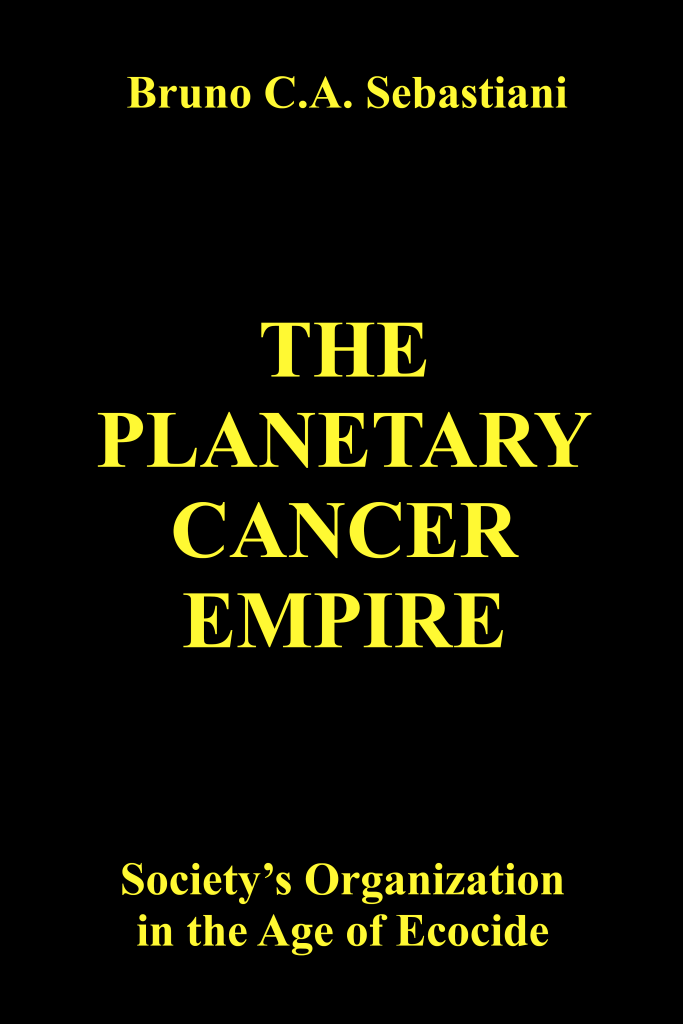
Society’s Organization in the Age of Ecocide
The Planetary Cancer Empire examines the next stage in the development of Cancerism: the transformation of human expansion into an increasingly interconnected planetary system.
As civilization grew more complex, humanity did not merely occupy new territories. It created political institutions, economic networks, technological infrastructures, cities, transportation systems, and forms of communication capable of linking populations across continents and extending human activity into virtually every region of the Earth.
The result is what this book calls the Planetary Cancer Empire: a global structure through which the malignant dynamics described in the first two volumes become organized, interconnected, and increasingly difficult to reverse.
Table of Contents
Preface — 9
1. Healthy Cells, Altered Cells, Diseased Cells — 11
2. The Symphony of Life — 21
3. The Global Village — 25
4. Old and New World Order — 29
5. Feeding Ourselves: The Problems of Agriculture — 37
6. The Problems of Land-Based Livestock Farming — 55
7. The Problems of Aquatic Animal Farming — 81
8. The Utopia of Agroecology — 103
9. Energy for Life — 111
10. The Postponement of the “Redde Rationem” — 127
Conclusion – For a New Third Great Cultural Revolution — 133
Appendix – The Precursors of Cancerism — 139
James Lovelock’s Recantation — 140
The Role of Thomas Malthus — 142
Peter Wessel Zapffe — 145
Arthur Koestler — 147
Thomas Ligotti — 153
Claude Lévi-Strauss and Daniel R. Wilson — 155
Warren M. Hern and Lynn Margulis — 157
Alan Gregg — 163
Frank Forencich — 165
Allan Kent MacDougall — 167
Rutilio Sermonti — 169
Daniel Pauly — 170
Lewis Mumford, Unwitting Cancerist — 172
Konrad Lorenz, Optimist in Spite of Everything — 174
Dennis Meadows, 40 Years after the Historic Report — 179
The Central Argument
Cancerism does not end with the behavior of individuals. For human expansion to reach planetary dimensions, billions of people must be organized, connected, supplied, transported, informed, and coordinated through increasingly complex social systems.
Over the course of history, states, markets, cities, transportation networks, industrial production, mass communication, and technological infrastructures have progressively linked once-separated human communities into an interconnected global civilization.
The Planetary Cancer Empire interprets this process as the organizational stage of the planetary malignancy. Human societies increasingly share the same technologies, patterns of production and consumption, forms of communication, and expectations of material progress. Cultural, linguistic, economic, and geographical barriers that once separated populations are progressively weakened.
This integration enormously increases humanity’s collective power, but it also makes civilization increasingly dependent upon the very systems that intensify its pressure on the biosphere. The networks created to sustain human life and prosperity become increasingly difficult to dismantle without threatening the society that depends upon them.
The central argument of this volume is therefore that the planetary malignancy has evolved from the expansion of a species into a self-reinforcing global system whose organization continually extends human power over the natural world.
Key Themes
Global Organization
Human expansion becomes increasingly powerful as isolated communities are incorporated into larger political, economic, and technological systems. Civilization transforms the activity of billions of individuals into a coordinated planetary force.
Networks and Infrastructure
Roads, cities, transportation systems, communications, energy networks, and digital technologies connect once-separated centers of human activity. These networks allow the processes of expansion, production, and consumption to operate on a global scale.
Cultural Homogenization
Languages, traditions, customs, lifestyles, and patterns of consumption progressively converge. The diversity of human cultures is increasingly replaced by standardized forms of life compatible with a globally interconnected civilization.
The Expansion of the System
Political institutions, markets, technology, and mass communication continually extend the reach of human civilization. What began as geographically limited centers of development becomes an increasingly integrated planetary structure.
Dependence on the Empire
The systems created to expand human power eventually become indispensable to human survival itself. Modern societies depend upon vast networks of energy, transportation, production, communication, and exchange that cannot easily be dismantled without destabilizing the civilization they sustain.
The Place of This Book in the Series
The Planetary Cancer Empire is the third of seven books through which the concept of Cancerism is progressively developed.
The first volume identifies the structural similarities between humanity’s expansion and malignant growth. The second introduces the paradox of consciousness: a species capable of recognizing the consequences of its behavior while continuing along the same trajectory.
This third volume shifts the focus from the individual human being to civilization as an organized system. It examines how political institutions, economic structures, technological networks, mass communication, and cultural homogenization have transformed scattered human societies into an increasingly interconnected planetary order. The malignancy has not merely expanded; it has organized itself. This progression is already anticipated in the earlier analysis, where social organization and interconnected networks are presented as essential to the disease reaching planetary dimensions.
Selected Excerpt
From Chapter 4, “Old and New World Order”
While many people, me included, talk about the big picture, 7.7 billion human beings need every day to drink, to eat, to dress, to shelter from the elements, to dispose of their waste, to defend themselves from disease and from the violence of other humans, and so on.
For these needs, for better or worse, public administrators take responsibility.
Or rather: producers produce, shippers distribute, merchants sell, and finally citizens—who in turn are producers, shippers, or merchants—buy and consume. But for this whole cycle to run smoothly, a ruling class is needed to manage the famous three powers: legislative, executive, and judicial.
As we saw in the previous chapter, there is not a shortage of such a ruling class but a glut.
The borders of the roughly 200 states that make up the administrative apparatus of planet Earth date back several decades, in many cases centuries, to a time when the possibilities for exchange were infinitely smaller than they are today.
Now we find ourselves in a situation in which human intellect—the engine of the planet’s cancer—through scientific discoveries and technology has enabled our species to multiply without measure and to communicate in real time with anyone anywhere, yet it still cannot blend races and nationalities as the disease’s evolution demands.
Let us look separately at the following:
– what the barriers to the cohesion of the cancer cells are
– why the evolution of the disease pushes toward that cohesion
The barriers to the cohesion of the cancer cells
To live always in the same place and to have no means of communicating with men and women living elsewhere leads to a cultural production and to the development of so-called local customs and practices. For millennia this was the condition of the vast majority of human beings.
To be sure, the more aggressive cells studied, traveled, and wrote. They were the ones who made the political, economic, scientific, and philosophical history of the planet. But the vast majority lived in the countryside, inside their dwellings—huts, stilt houses, tipis, yurts, izbas, or trulli—developing languages, myths, and rituals that differed from place to place.
Little of that reality remains: the ever-decreasing use of dialects, traditional recipes, a few old legends still handed down, and regional costumes brought out for village festivals or to entertain foreign tourists.
Many people miss that kind of life and try to keep local traditions alive. However admirable their efforts may be—they want to preserve ways of life more “on a human scale,” as the cliché goes—their undertaking is doomed to defeat, like an aborigine fighting with bow and arrows against rifles and cannons.
At this point clarification is needed. I realize there is a danger that my observations about the triumph of the new may be mistaken for positive value judgments about the order being established. Nothing could be more wrong. Readers of my work know that to me the new, the advancing technoscience, represents the attainment of a more advanced stage of the disease that is destroying the biosphere and of which we are the cancerous agents.
My judgment of the novelties reshaping the world and our ways of life is therefore sharply negative, yet I cannot refrain from recording their occurrence, from trying to understand their inner reasons, and from asking what the next forced evolutions will be.
Critical Reception
“The Planetary Cancer Empire by Bruno Cesare Antonio Sebastiani is a comprehensive and thorough multidisciplinary analysis of humanity’s destructive impact on Earth, analyzed through the metaphor of humans as cancer cells of the biosphere.”
“The book is a dense and challenging read, packed with quantitative and qualitative data, complex theories, and careful references to every hypothesis and idea it presents. Its thoroughness can feel overwhelming at times, yet it rewards persistent and curious readers with very profound and pragmatic insights.”
Ashley Roby, Reedsy Discovery
Book Details
Series: The Planet’s Cancer — Volume III of VII
Author: Bruno C.A. Sebastiani
Genre: Nonfiction · Environmental Thought · Philosophy · Anthropology
Continue the Series
Revelation
The fourth volume, Revelation, changes perspective again. Having described the origins, consciousness, and organization of the planetary malignancy, the series turns directly toward humanity itself—addressing the malignant cells and confronting them with the condition they have created.
What happens when the diagnosis is addressed directly to the malignant cells themselves?
