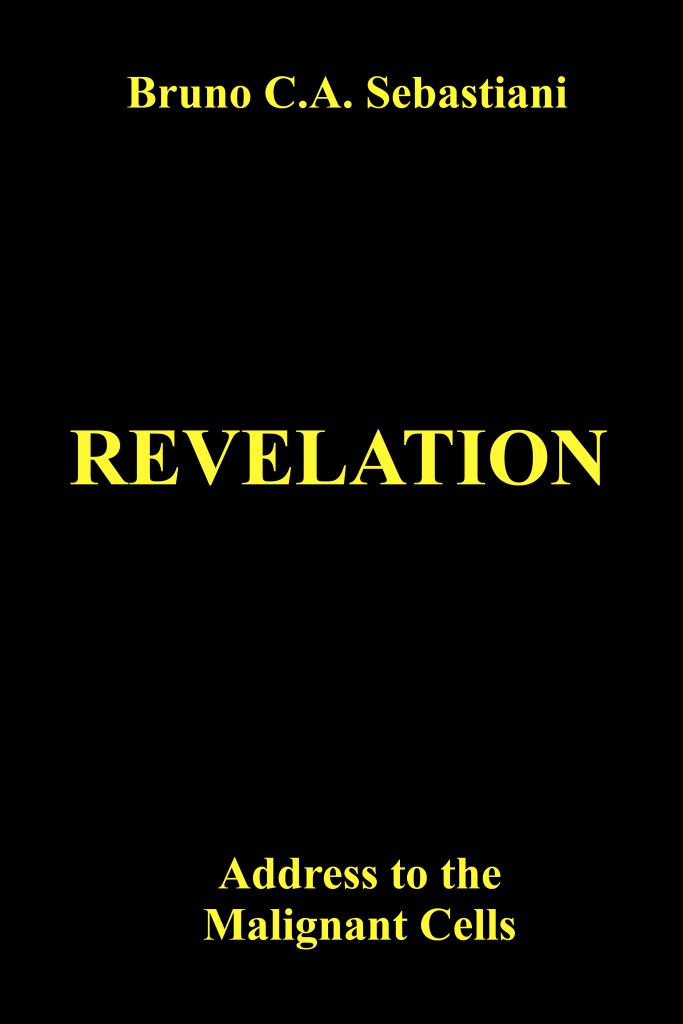
Address to the Malignant Cells
Revelation marks a change of voice within The Planet’s Cancer series. After examining humanity as a planetary malignancy, the emergence of its consciousness, and the global system through which its expansion has become organized, this book turns directly to the malignant cells themselves.
Human beings are no longer observed only from the outside. They are addressed as members of a species capable of understanding what it has become, what it has done to the biosphere, and the contradiction inherent in continuing to destroy the living system on which its own existence depends.
The question is therefore no longer simply how the planetary malignancy arose or how it operates. It is whether consciousness can alter the behavior of a species after that species has recognized its own condition.
Can a conscious malignancy change its behavior once it understands what it is doing to its host?
Table of Contents
Preface — 9
1. The Exit from the State of Nature — 13
Merlin Donald’s Hypothesis — 16
Richard Leakey’s Hypothesis — 17
Jared Diamond’s Hypothesis — 19
Ian Tattersall’s Hypothesis — 22
Richard Wrangham’s Hypothesis — 23
Yuval Noah Harari’s Hypothesis — 25
Pietro Buffa’s and Mauro Biglino’s Hypothesis — 27
2. The Transition to Mythic Culture — 33
Primitivism and Animism — 38
The Destruction of Nature in Antiquity — 41
The Age of Myths — 48
3. Birth and Spread of the Great Fable — 53
The Omnipotence and Omnipresence of God — 60
The Role of Art in Portraying the Sacred — 66
4. Reason Prevails over Faith — 71
Sitting Around the Bonfire — 75
5. A One-Way Road — 77
The One-Way Course of Evolution — 80
The Tragedy of Irreversibility — 89
6. The Limits of Intelligence — 93
Our Intelligence Between Microcosm and Macrocosm — 94
How Does Our Brain Work? — 96
Toward More Powerful Brains With More Memory? — 99
7. Revelation — 105
Before the Watershed Event — 106
The Watershed Event — 109
The Unanimity of Consensus on the Notion of Superiority — 111
After the Watershed Event — 121
The Concluding Revelation — 123
A Brief Excursus Into Mysticism of Every Age — 125
Conclusion — 135
The Central Argument
The evolutionary development of the human brain gave Homo sapiens powers no other species possessed. Human beings became capable of transcending instinctive constraints, transforming their environment, constructing artificial systems, and progressively placing the natural world at their service.
Revelation identifies this transition as the decisive rupture in humanity’s relationship with the biosphere: the moment when our species ceased merely to live within nature and acquired the power to alter the conditions under which life itself had evolved.
Civilization has traditionally interpreted this development as evidence of human superiority. Philosophy, religion, science, and technology have repeatedly reinforced the conviction that intelligence confers upon humanity a privileged position among living beings. This book reverses that perspective. The very faculty celebrated as the source of our greatness is also what enabled us to destabilize the natural order on which we depend.
The paradox becomes more disturbing because our intelligence has limits. We can transform ecosystems of extraordinary complexity, but we cannot fully understand, reproduce, or restore the countless relationships through which those ecosystems evolved over millions of years.
Human intelligence has proved powerful enough to disrupt the balance of the biosphere, but not powerful enough to recreate the balance it has destroyed.
Key Themes
The Reversal of Human Superiority
Human intelligence has traditionally been celebrated as the defining achievement of our species. Revelation reverses this perspective, asking whether the faculty that gave humanity its extraordinary power may also be the source of its destructive relationship with the biosphere.
Intelligence Beyond Ecological Limits
The human brain enabled Homo sapiens to escape many of the constraints that regulate other living species. That freedom allowed civilization to grow, transform nature, and progressively replace natural processes with artificial systems.
The Limits of Human Knowledge
Human beings can intervene in systems whose complexity they only partially understand. The capacity to alter nature therefore exceeds the capacity to foresee all the consequences of that alteration or to reconstruct the equilibrium that has been lost.
Awareness Without Reversal
Humanity is capable of understanding many of the consequences of its actions, yet the evolutionary and civilizational process that produced those actions cannot simply be undone. Consciousness reveals the contradiction without necessarily providing a way out.
A Message to the Malignant Cells
The distinctive voice of Revelation is direct. Humanity is no longer merely the object of analysis: it becomes the addressee. The diagnosis established by Cancerism is turned into a question addressed to the species itself: what can knowledge of our condition still change?
The Place of This Book in the Series
Revelation is the fourth of seven books through which the concept of Cancerism is progressively developed.
The first volume, The Planet’s Cancer, introduces the biological analogy between humanity’s expansion and malignant growth. The second, The Planet’s Conscious Cancer, examines the paradox of a species capable of recognizing the damage it causes while continuing to produce it. The third, The Planetary Cancer Empire, shifts the focus to the political, economic, technological, and cultural structures through which human expansion has become organized on a global scale.
Revelation marks a turning point in the series. Having described the origin, development, consciousness, and organization of the planetary malignancy, the argument now turns toward humanity itself. The diagnosis becomes an address to the malignant cells: a confrontation between what our species believes itself to be and what Cancerism claims it has become within the biosphere.
Selected Excerpt
From Chapter 7, “Revelation” — “The Concluding Revelation”
The time has come, I believe, to take stock and offer humanity a comprehensive revelation—non-mythological, non-spiritual, very concrete and, at the same time, all-encompassing.
It is the acrobatic exercise I am about to attempt.
We know nothing that is not “nature.” We can invert this and say that everything we know is “nature.” By “know” I mean “experience,” “perceive” with the senses. And, obviously, we can perceive only those portions of reality adjacent to us, belonging to the natural world.
Likewise we can say that what reaches our senses, and from there our brain, is the same reality that reaches the senses of every other living being and its command organ.
Nature is therefore perceived at the sensory level in a similar way both by the human being and by every other living being, with the differences inherent in the specific properties that characterize each plant’s or animal’s sensory organs.
The dog, for example, senses olfactory stimuli in far greater measure than we can, and the eagle spots objects, plants, and animals at distances far beyond what our eyes allow. The one has a more developed sense of smell than ours; the other, of sight.
Reality—what we call nature—is the same, but the perception each living being draws from it depends on the sensory organs it possesses.
These differences are irrelevant for our “address to the malignant cells.”
The difference that does interest us, supremely so, is the use we make of the perceptions once they reach our brain, as compared with the use other living beings make of them once they reach their command organs.
Let us begin by noting that we are not facing a crossroads with two clearly defined directions. We are at the starting point of as many roads as there are living species.
Each has its own brain—which I have more broadly called a “command organ” so as to include less complex species down to the plant world (even plants receive sensations and react to them).
These command organs receive the data sent by the senses, process them, and execute the behaviors deemed most appropriate—and within “process them” lies the most important part of the discussion.
I do not believe—or at least I am unaware—that a unit of measure has been defined for the processing capacity of living beings’ command organs, analogous to how one measures computer processing power (operations per second, amount of RAM, etc.).
But certainly such measures exist, however difficult to define. For simpler organisms they allow basic, immediate reactions; for more complex ones, more sophisticated reactions—but always within what the laws of nature provide. What does this mean? That higher animals, alongside their command processor, also have a memory; the two together can enable more evolved thought processing based on the power of calculation and the memory at their disposal (the analogy with computers, I believe, helps clarify the point).
Crossing the well-known threshold (the watershed between the “before” of the natural world and the “after” of the artificial world) produced the birth of abstract thought and the capacity for self-reflection typical of the human being.
But beyond that threshold there could be infinitely many others. If the neurons contained in our brain number between 80 and 100 billion, nothing prevents us from imagining brains with twice as many neurons capable of elaborating far more complex reasonings and mastering reality much more fully than we can.
This hypothesis is entirely logical—but it is also well known that our encephalon, as already noted, cannot grow further; nor are there currently beings in circulation with brains capable of growing in the way indicated.
And more powerful brains could only create more catastrophic disasters, because they would still be nothing compared to Nature’s power.
I believe this is the Concluding Revelation that ought to put an end to our search: we are nothing in the face of the immensity of the universe and, though we possess processing capacities far greater than all the other living beings inhabiting planet Earth, we remain unsuited and unable to grapple with the mysteries surrounding us.
The ant and the nuclear power plant give us a pale idea of the cognitive distance between us and the sidereal spaces.
Critical Reception
“A provocative and deeply philosophical work that challenges humanity’s most cherished assumptions.”
“A bold, unsettling perspective.”
Jason Munoz, Reedsy Discovery
Book Details
Series: The Planet’s Cancer — Volume IV of VII
Author: Bruno C.A. Sebastiani
Genre: Nonfiction · Environmental Thought · Philosophy · Anthropology
Continue the Series
The Limits of Intelligence
The fifth volume examines the paradox introduced in Revelation: human intelligence has become powerful enough to transform and damage natural systems of extraordinary complexity, yet it remains incapable of fully understanding or recreating the ecological relationships that sustain them.
The Limits of Intelligence develops this contradiction through science, philosophy, technology, and artificial intelligence, asking whether the faculty that enabled humanity to dominate nature may also be fundamentally inadequate to repair what it has destroyed.
