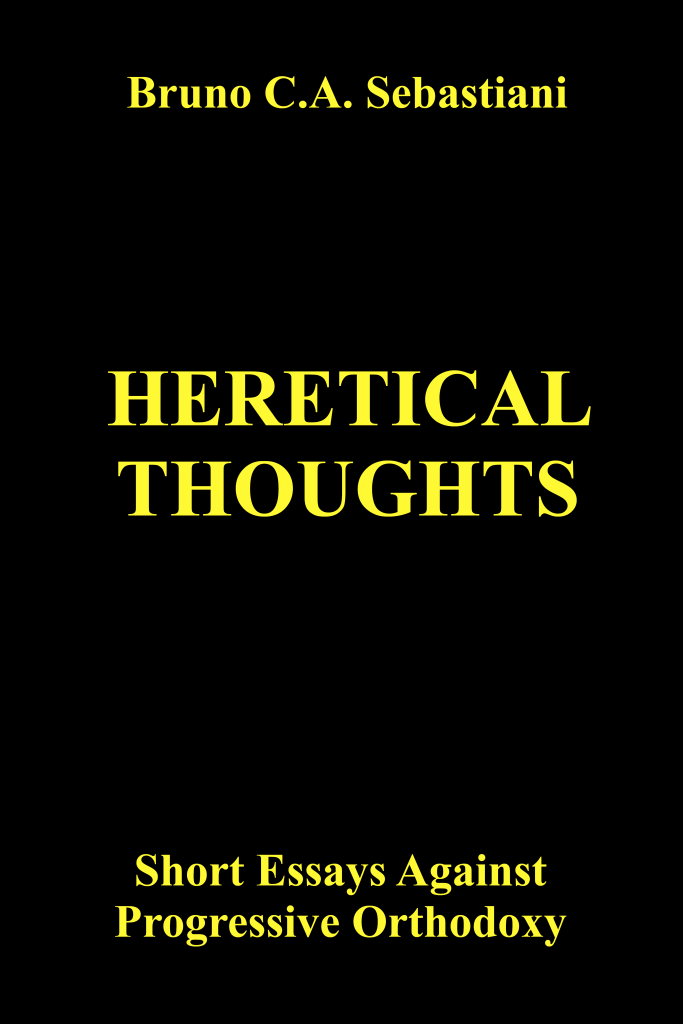
Short Essays Against Progressive Orthodoxy
Heretical Thoughts is the seventh and concluding volume of The Planet’s Cancer series. Unlike the preceding books, it does not develop Cancerism through a single continuous argument. Instead, it brings together a wide-ranging collection of short essays written around the theory and its implications, approaching the human condition from historical, philosophical, ecological, cultural, and political perspectives.
The essays challenge what the book calls the dominant orthodoxy of modern civilization: the conviction that human intelligence, scientific progress, technological development, and the growing power of humanity over nature must ultimately be regarded as positive achievements. The collection turns that assumption upside down, asking whether the very capacities we celebrate most may instead lie at the origin of the ecological crisis.
Its subjects range widely—from asceticism, Romanticism, industrialization, meat consumption, natalism, artificial intervention in nature, work, science, free will, and antispeciesism to the limits of knowledge, the will to power, apophatic thought, beauty, and the philosophical foundations of Cancerism. The anthology format allows each question to be examined independently while remaining connected to the broader critique developed throughout the series.
As the author explains in the Preface, these thoughts are called “heretical” because they reject the almost universal belief that human intelligence represents nature’s highest achievement. Against that orthodoxy, the book attempts to make thinkable a radically different interpretation of human progress.
What if the ideas modern civilization regards as heretical are precisely the ones needed to understand what progress has done to the living world?
Table of Contents
Preface — Six Books to Change the World — 11
1. The Planet’s Cancer — 15
2. The Planet’s Conscious Cancer — 19
3. The Planetary Cancer Empire — 23
4. Revelation — 27
5. The Limits of Intelligence — 31
6. P.I. Personal Index — 35
The Path of Progress and Its Opponents — 39
1. Eastern And Western Asceticism — 41
2. The Middle Ages Between Opposing Tensions — 45
3. The Discovery of the New World — 49
4. Romanticism Erupts in Europe — 55
5. The English Craftsmen Against the Industrial Revolution — 61
6. Those Who Long for the Wilderness — 65
7. Kierkegaard, Dostoevsky and Nietzsche in Lev Shestov’s Analysis — 69
Other Articles on Various Blogs — 81
De-Differentiation — 85
What If All the Buildings on Earth Were Single-Story? — 91
Cancerism as an Overcoming of Deep Ecology — 95
Malignant Species — 101
Angels or Demons? — 105
When Did We Become Human? — 109
An Enigmatic Monument — 115
Children of the Stars? — 121
Meat or No Meat — 125
Natalism or Antinatalism — 133
The Real Culprit — 137
Chance and Guilt — 141
The Artificial Mixing of Species — 147
Stop Formula 1 — 151
Open Letter to the Young People — 153
The Green Business That Awaits Us — 155
Reflections on Cancerism — 159
Was Aurelio Peccei a Forerunner of Cancerism? — 165
The Dog, the Cat, and I — 173
Cancerism and the Pandemic — 175
The Anti-Vax Movement and Its Surroundings — 179
For a Reassessment of Antispeciesism — 185
The Tallest Tower — 191
UniCredit’s Point of View — 195
The Rhetoric of Work — 199
Cancerism and Free Will — 205
Enough Science! — 209
The Amish, the “Simple People” Who Reject Progress — 213
The Adaptability of the Human Species — 219
Are We Viruses or Cancer Cells? — 223
The Repugnance of Sex — 227
Why Say No to Extinctionism — 231
Cancerism and Love of Life — 235
What Is ‘Against Nature’ — 239
Knowing That We Cannot Know — 245
Self-Preservation Instinct and Will to Power — 249
The Half-Naked Vegetarian — 253
In Defense of Apophatism — 257
Ideas for a New Cultural Revolution — 261
One, No One or One Hundred Thousand? — 265
Contra Philosophos (Against the Philosophers) — 269
Beauty Will Save the World — 275
How to Convince Those Who Do Not Want to Be Convinced — 279
Was Jean Servier a Precursor of Cancerism? — 283
Afterword — 289
The Central Argument
Heretical Thoughts begins from a reversal of one of the most deeply rooted assumptions of human civilization: that the development of intelligence, reason, science, technology, and material progress represents an unquestionable advance.
Across the essays collected in this volume, that assumption is repeatedly challenged. Human intelligence is examined not simply as the faculty that produced civilization, but as the evolutionary development that enabled one species to escape many of the natural constraints governing every other form of life and to transform the biosphere on an unprecedented scale.
The “heresy” of the book therefore consists in questioning what modern culture usually treats as self-evident. Progress may improve human life while simultaneously degrading the conditions that sustain life as a whole. Scientific knowledge may increase our power without giving us the wisdom or cognitive capacity required to understand every consequence of its use. And the domination of nature may represent not humanity’s greatest achievement, but the clearest expression of its pathological relationship with the living world.
Because the book is an anthology rather than a continuous treatise, these questions are approached from many directions—history, philosophy, ecology, religion, ethics, politics, science, and everyday life. Subjects as different as industrialization, meat consumption, natalism, free will, work, antispeciesism, technological progress, and the limits of knowledge become different ways of examining the same underlying problem.
The purpose is not to replace one orthodoxy with another, but to make possible a reversal of perspective: to question humanity’s privileged interpretation of itself and to ask whether ideas dismissed as pessimistic, anti-progressive, or heretical may reveal something that the dominant worldview is unable—or unwilling—to see.
The final challenge of Cancerism is therefore intellectual before it is political: can humanity question the very ideas through which it learned to regard its own expansion as progress?
Key Themes
Progress as an Orthodoxy
Modern civilization largely treats scientific, technological, and material progress as inherently desirable. Heretical Thoughts challenges that assumption at its root. What humanity celebrates as advancement may simultaneously represent an accelerating transformation of the natural world for the benefit of a single species. The book’s “heresy” begins by refusing to accept progress as an unquestionable good.
Human Intelligence as an Evolutionary Problem
Throughout Cancerism, the exceptional development of the human brain is interpreted not simply as humanity’s greatest evolutionary achievement, but as the origin of its unprecedented capacity to dominate and alter nature. The essays repeatedly return to this reversal of perspective: intelligence gave Homo sapiens extraordinary power, yet that power has disrupted ecological relationships that evolved over immense periods of time.
The Forgotten Resistance to Progress
The belief in progress has never been completely universal. Ascetics, religious traditions, philosophers, writers, craftsmen, and movements hostile to industrial or technological expansion repeatedly questioned the value of humanity’s increasing domination of nature. Several essays reconstruct this neglected counter-history, asking whether those who resisted the march of progress understood something that modern civilization chose to ignore.
The Limits of Knowledge and Human Centrality
Human beings possess immense intellectual power, but that does not imply unlimited knowledge. Essays on science, free will, apophatic thought, the limits of intelligence, and “knowing that we cannot know” challenge the conviction that reason can ultimately explain, control, and reorganize the living world. The deeper philosophical consequence is a rejection of anthropocentrism: humanity is not outside or above nature, but one component of a vastly more complex system it cannot fully comprehend.
The Place of This Book in the Series
Heretical Thoughts is the seventh and final volume of The Planet’s Cancer series.
The first five books develop Cancerism through sustained argument, while P.I. Personal Index introduces a separate dystopian and satirical perspective. This final volume returns to the intellectual territory of Cancerism, but in a different form: a collection of shorter essays written over several years and devoted to specific aspects of the theory and its wider implications.
Rather than adding another systematic stage to the theory, Heretical Thoughts revisits, extends, and tests many of the questions raised throughout the preceding books—progress, human intelligence, anthropocentrism, technology, knowledge, ecology, and humanity’s relationship with the rest of the living world. The anthology format also allows the discussion to move beyond the central biological analogy and into broader cultural and philosophical territory.
As the closing volume, it therefore functions less as a conclusion than as a set of further perspectives on the ideas developed across the series.
Selected Excerpt
From “Cancerism and Love of Life” (September 2020)
Accusing man of being the cancer of the planet may, to some, imply an excessive form of misanthropy, if not outright hatred of life in general.
Nothing could be more mistaken as regards Cancerism, the theory I have been striving for years to uphold and spread, which in fact expresses the opposite position: hatred for the deviant form of life induced in our species by the abnormal evolution of the brain arises from the deepest and most visceral love for life as it developed on our planet over millions and millions of years.
The second chapter of my book “The Planetary Cancer Empire” is entitled “The Symphony of Life” and seeks to establish a parallel between the harmony reigning in nature and the majesty of the compositions of the greatest musicians.
The genetic alteration that caused our disastrous cerebral growth is likened to the dissonances that may arise from errors of interpretation.
[…] let us think what would happen to a Beethoven symphony if some presumptuous orchestral player decided from a certain point onward to replace every A with a G, or every C with a B, or to make even more brainy alterations. The harmony would be broken and the result would be disastrous. Well, this is what we have done to the nature of the biosphere. And the symphony of life now risks turning into a tragic concert for the end of the world.
Book Details
Series: The Planet’s Cancer — Volume VII of VII
Author: Bruno C.A. Sebastiani
Genre: Nonfiction · Environmental Thought · Philosophy · Cultural Criticism
