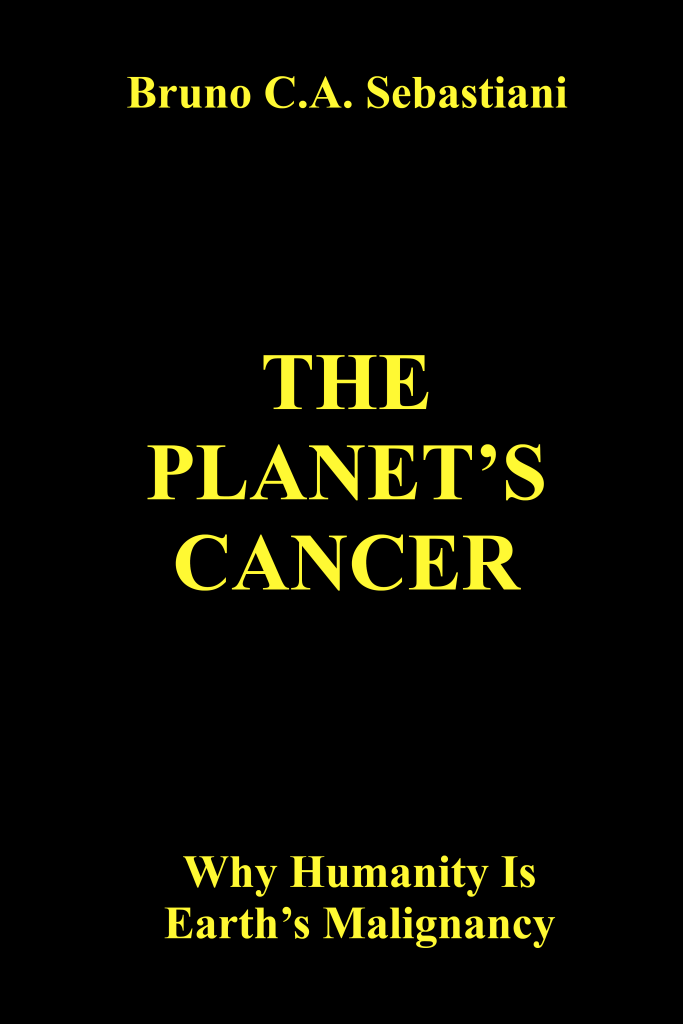
Why Humanity Is Earth’s Malignancy
The Planet’s Cancer introduces Cancerism, an interpretive framework that examines the relationship between humanity and the biosphere through a disturbing biological parallel.
A malignant tumor arises when cells belonging to an organism cease to respect the regulatory mechanisms that make the life of the whole possible. They proliferate, appropriate resources, invade surrounding tissues, spread into new territories, and ultimately endanger the organism on which their own survival depends.
This book asks whether the extraordinary expansion of Homo sapiens displays a comparable structural pattern on a planetary scale.
Table of Contents
Preface — 9
1. Contemplation from the Heights of the Heavens and the Depths of the Abyss — 11
2. The Brain: Root of All Evil — 15
3. Cancer in Man, Cancer in the Planet — 21
4. The Original Sin That Turned Us into Tumor Agents — 27
5. The First Steps of Cells in Transformation — 31
6. Tumor Cells Multiply — 33
7. Tumor Cells Cluster — 37
8. The History of the Evolution of Disease — 45
9. From Proto-Myths to the Dawn of Reason The Three Thousand Years That Shook the World — 49
10. The Cradle of Abstract Thought, Where the Tumor Grows — 55
11. Plato’s “Second Sailing”: A Symbol of Man Overstepping Nature’s Laws — 61
12. The Functioning of the Brain Finds Its Illustrator — 65
13. Rome’s Power Spreads the Disease Across the West — 69
14. Judaism, Christianity, and Islam Great Religions That Unite Peoples and Sweep Away the “False and Lying” Gods — 73
15. The Middle Ages: Conflicting Tensions — 77
16. Renaissance, Humanism, Enlightenment: Three Preliminary Stages before the Disease Explodes — 85
17. From Words to Deeds: The Age of Political Revolutions — 91
18. Science, Technology, Industry: A Triad for the Planet’s Destruction — 95
19. Life Beyond Death: The Myth of Eternal Youth — 105
20. Bonapartism and the New Nation-States Spread Human Inventions Everywhere — 109
21. Between Dictatorships and Liberal Democracies in the Twentieth Century the Malady Spreads — 113
22. The Twenty-First Century Ahead: Between Religious Integralism and the Mixing of Peoples — 119
23. The China Case — 125
24. The Limits to Growth and the Various Ecologies that Would Like to Stabilize Disease — 127
25. The Unworkable Solutions to the Problem of Overpopulation — 143
26. The Images of Change — 149
27. A Modest Book for a Big Theory Yet to Be Developed — 153
28. Cosmic Pessimism and Individual Optimism — 157
Conclusion — 161
The Central Argument
Humanity is not an external force acting upon nature. It emerged from the biosphere and remains completely dependent upon it.
Yet one species has progressively escaped many of the ecological constraints that regulate other living populations. Through intelligence, technology, agriculture, industry, and increasingly powerful forms of social organization, human beings have multiplied, expanded across the planet, appropriated an ever-growing share of its resources, transformed ecosystems, and displaced innumerable other species.
The Planet’s Cancer argues that these phenomena should not be considered merely as a collection of separate environmental problems.
Seen together, they reveal a coherent pattern.
Cancerism proposes that the ecological trajectory of human civilization bears significant structural similarities to malignant growth within a living organism. The analogy is not intended as a moral condemnation of humanity, but as an instrument for understanding the dynamics of its expansion.
Key Themes
Uncontrolled Growth
Technological and social development progressively weakened many of the environmental constraints that had historically limited human population and activity.
Resource Appropriation
Human civilization redirects an increasing proportion of the planet’s land, water, biomass, minerals, and energy toward the requirements of a single species.
Territorial Expansion
From a geographically restricted origin, Homo sapiens progressively occupied and transformed virtually every terrestrial environment accessible to it.
Ecological Homogenization
Complex ecosystems are increasingly replaced by environments designed around human requirements: cities, agricultural land, infrastructure, industrial systems, and standardized landscapes.
Dependence on the Biosphere
Like malignant cells within an organism, humanity cannot exist independently of the system whose stability its expansion increasingly threatens.
The Place of This Book in the Series
The Planet’s Cancer is the first of seven books through which the concept of Cancerism is progressively developed.
This opening volume establishes the biological and ecological foundations of the argument. The books that follow examine its consequences for consciousness, civilization, politics, intelligence, social organization, and humanity’s understanding of its own place in nature.
Selected Excerpt
From Chapter 2, “The Brain: Root of All Evil”
The reflections set out here and in the following pages might seem to suggest a teleological aim, an intent to change human attitudes toward themselves, toward one another, and above all toward nature. Nothing could be further from the truth.
My reflections aim only to reveal reality from a particular perspective: that of nature itself. My intent is to observe human action not from an “anthropocentric” point of view, but from a “geocentric” (or even “cosmocentric”) one, fully aware that such observation, however tragic and radically pessimistic, will have no effect in altering the fundamental behavior of humankind.
And this is precisely because of the evolutionary path taken by the human brain, which is driven to grow and to expand at the expense of other living beings (plants, animals, the ecosystem as a whole) producing destructive imbalances that no remedy will ever undo. Until life as we know it is extinguished on this planet, and nature reclaims its supremacy in ways we cannot foresee.
The central point is precisely this: the human brain is the engine of change (shall we call it of so-called “progress”?). This is a simple observation, yet one that gives rise to diametrically opposed judgments depending on the perspective.
From an anthropocentric point of view: the “magnificent and progressive destiny” of humanity.
From a geocentric point of view: the progressively and irreversibly destructive effect of the human brain’s actions (or of man through his brain, which amounts to the same).
It should also be noted that when we speak of an “anthropocentric” view, it would be more accurate to call it an “immediate, self-interested, anthropocentric view of the privileged or emerging strata of humanity.” For, if man truly cared not only for his immediate gain but for the broader survival of his species, the anthropocentric and geocentric perspectives would converge.
But it is not so. And meanwhile, the human brain continues its expansion, driving our species toward ever further alterations of the planet’s systems, the foremost being the sheer number of humans alive, with the multiplying effect of planetary destruction that follows.
Could things have been otherwise? Certainly not through human action. Yes, an asteroid might have struck Earth and wiped out all life. But absent such external disturbances, humankind has been, paradoxically, the passive subject of its so-called “evolution.” It has found itself with a powerful, ever more powerful instrument, the brain, at its disposal, and has used it for its own benefit. That is all.
Could it be used differently? Does free will exist? Not when it comes to the brain. Just as a stone placed on a slope and pushed can only roll downward, so too, once the brain set out on the path of its formidable expansion (thanks to evolutionary conditions), it could only increase its rational power and turn it to its own advantage. The instinct for survival, present in all living beings, finds in humankind its strongest weapon, the brain, and uses it to extend its power.
Critical Reception
“The Planet’s Cancer by Bruno Cesare Antonio Sebastiani is an important and timeless work that offers a philosophical and historical analysis of humanity’s relationship with Earth.”
“This is a radical dive into ecological pessimism and anti-humanist philosophy, which is both compelling and thought-provoking.”
Ashley Roby, Reedsy Discovery
Book Details
Series: The Planet’s Cancer — Volume I of VII
Author: Bruno C.A. Sebastiani
Genre: Nonfiction · Environmental Thought · Philosophy · Anthropology
Continue the Series
The Planet’s Conscious Cancer
The second volume, The Planet’s Conscious Cancer, examines the emergence of consciousness and the paradox of a species capable of recognizing the consequences of its expansion while continuing to pursue it.
What happens when the planetary malignancy becomes capable of understanding what it is doing?
