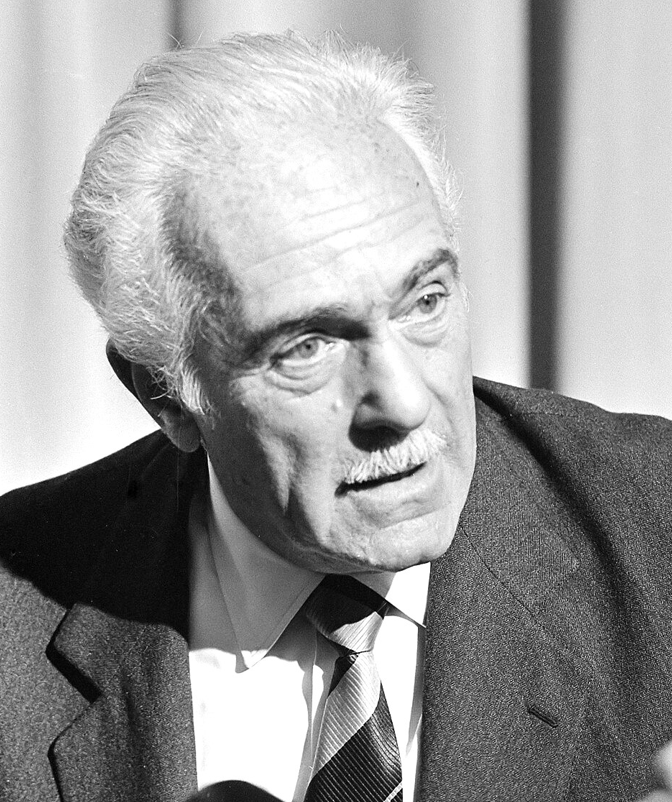
Aurelio Peccei (1908–1984) was an Italian industrialist, economist and international thinker who co-founded the Club of Rome in 1968 and served as its first president. He devoted much of his later life to examining interconnected global problems, particularly population, resource use, technological growth and the long-term limits facing human civilization.
A Precursor in Tension with Cancerism
Aurelio Peccei occupies a particularly interesting position among the precursors of Cancerism. He did not formulate a theory of humanity as a malignant process within the biosphere, yet at several moments he came remarkably close to ideas that would later become central to Cancerism.
In One Hundred Pages for the Future, Peccei included a section entitled “Cancerous Metastasis of the Population.” The expression was directed primarily at overpopulation, but his reflections went significantly further.
He asked whether Homo sapiens might represent not the summit of evolution, but an accident or error within it:
“Was it in an exceptional surge of creativity, or in a moment of bewilderment, that nature produced its last great species, the one to which we have given the name Homo sapiens? Is this its masterpiece, or is it merely a misprint that escaped the control of immediate selection, or perhaps something admitted only conditionally into the great flow of life?”
The question is strikingly close to one of the central problems later developed by Cancerism.
Humanity is no longer assumed to be the triumphant culmination of evolution. Peccei instead entertains the possibility that Homo sapiens may constitute an evolutionary anomaly.
A Deviant Species?
Peccei returned repeatedly to this possibility.
He asked whether Homo sapiens might be:
“a deviant phenomenon”
or:
“a caprice of nature, or an ambitious attempt gone wrong, a manufacturing error”
which the mechanisms maintaining life might eventually eliminate or correct.
He also questioned the role of human intelligence.
Technical capacities, he suggested, may have placed humanity upon an excessively high pedestal. Rather than demonstrating human genius, the global disorder produced by civilization might reveal something fundamentally defective.
Peccei even envisaged the possibility that humanity could become the victim of its own destructive activity, condemned by an intelligence that had acquired extraordinary power without an equivalent capacity to govern its consequences.
Here the affinity with Cancerism becomes particularly strong.
Cancerism likewise identifies the abnormal evolutionary development of the human brain as the decisive event that allowed one species progressively to escape ecological constraints, dominate the environment and transform the biosphere on a planetary scale.
Cancerous Growth
Peccei’s use of the expression “Cancerous Metastasis of the Population” is especially significant.
The analogy links demographic expansion with one of the defining characteristics of malignant disease: uncontrolled proliferation and spreading.
Peccei was deeply concerned by the rapid increase of the human population and by the corresponding pressure on resources, ecosystems and the global environment.
For this reason, population growth became one of the central concerns of the Club of Rome and of the debate surrounding The Limits to Growth.
Cancerism develops the comparison further.
Population growth is only one manifestation of a larger malignant process that also includes technological expansion, resource appropriation, ecological invasion, the destruction of other species and the progressive transformation of the biosphere into an environment increasingly organized around the needs of a single species.
Where Peccei Diverges from Cancerism
Despite the radical nature of some of his questions, Peccei never abandoned hope in humanity.
After asking whether Homo sapiens might be an evolutionary error, he provisionally suspended judgment in humanity’s favor.
He repeatedly returned to the conviction that the human condition, however grave, could still be improved.
“Man can save himself; it is up to us to find the way.”
This optimism marks an important boundary between Peccei and Cancerism.
Peccei believed that humanity might undergo a profound cultural and spiritual transformation. He hoped for a new form of humanism capable of reconciling human civilization with Nature.
His goal remained the transformation of humanity rather than the recognition of humanity itself as an intrinsically malignant process.
He therefore remained fundamentally anthropocentric.
Human beings were expected to change in order to preserve their central place within the world, albeit in a more responsible and harmonious form.
The Human Quality
This tension runs through much of Peccei’s thought.
On the one hand, he was acutely aware of the destructive consequences of population growth, industrial expansion and technological power.
On the other, he retained faith in education, political organization, global planning and the improvement of what he called “the human quality.”
He hoped for a world in which human beings could fully develop their best qualities while living in greater symbiosis with Nature.
Cancerism departs from this position.
Its central question is not primarily whether human beings can become wiser, more ethical or better governed, but whether the biological and evolutionary characteristics that allowed Homo sapiens to dominate the planet contain a structural tendency toward unlimited expansion and environmental destruction.
Why Peccei Belongs among the Precursors
Peccei cannot be described as a precursor of Cancerism in the same sense as thinkers who explicitly developed the analogy between humanity and malignant disease.
His importance lies elsewhere.
He seriously entertained several ideas that later became central components of the Cancerist framework:
- human population growth described in terms of cancer and metastasis;
- Homo sapiens considered as a possible evolutionary anomaly;
- the possibility that humanity might represent a biological “manufacturing error”;
- human intelligence seen as a potentially dangerous evolutionary endowment;
- technological power as a force capable of amplifying human destructiveness;
- recognition of the incompatibility between unlimited growth and a finite planet;
- awareness that humanity may become the victim of its own expansion.
Peccei ultimately rejected the most pessimistic implications of these intuitions and continued to believe in human transformation.
But the questions he asked remain extraordinarily close to those from which Cancerism later developed.
Key Affinities with Cancerism
- Population growth described as cancerous and metastatic
- Homo sapiens as a possible evolutionary anomaly
- Humanity as a potential “manufacturing error”
- Intelligence as a possible source of ecological imbalance
- Technological power amplifying human destructiveness
- Recognition of planetary limits
- Concern with population pressure and resource depletion
- Humanity potentially becoming the victim of its own activity
Point of Divergence
- Peccei retained faith in human transformation, global planning and a new humanism, whereas Cancerism questions whether the fundamental problem can be corrected without confronting the evolutionary characteristics that made Homo sapiens a dominant planetary force.
Works Discussed
Aurelio Peccei, The Human Quality (1976).
Aurelio Peccei, One Hundred Pages for the Future (1981).
Adapted from Bruno C.A. Sebastiani, Heretical Thoughts.
