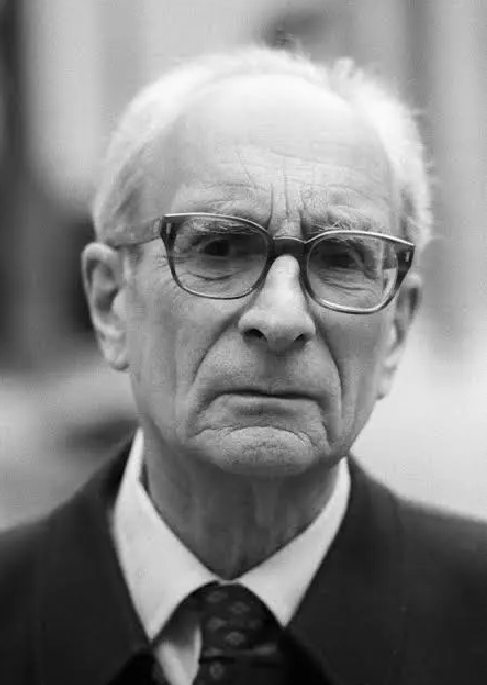
Claude Lévi-Strauss (1908–2009) was a French anthropologist and one of the principal founders of structural anthropology. Professor of Social Anthropology at the Collège de France from 1959 to 1982, he transformed the study of kinship, mythology and classification while repeatedly questioning Western assumptions about civilization, progress and humanity’s place within nature.
From Wilson to Lévi-Strauss
Claude Lévi-Strauss approached the comparison between humanity and cancer through the work of Daniel R. Wilson.
In an essay published in 2000, he introduced Wilson’s theory by observing that the proliferation of the human species could be assimilated to a cancer of the planet. He described Wilson’s demonstration as technically rigorous and impressive, while acknowledging that he himself could offer only a simplified account of it.
Lévi-Strauss then summarized Wilson’s pathological reconstruction of human history: the emergence of humanoid populations, the malignant transformation associated with agriculture, the formation of urban concentrations, metastatic expansion through colonization, planetary pollution and finally the systemic deterioration of the terrestrial environment.
But Lévi-Strauss’s real contribution begins after this summary.
More Than an Ingenious Metaphor
Lévi-Strauss asks what can be learned even if the comparison between humanity and cancer is initially regarded only as an ingenious metaphor.
His answer is important.
The fact that the same language can describe in remarkable detail two phenomena belonging to different scales of life suggests, for him, that there may be a structural relationship between them.
One phenomenon concerns the history of an individual organism affected by cancer.
The other concerns the collective history of the human species within the planetary ecosystem.
The correspondence does not depend on the two phenomena being literally identical.
What matters is that they may display the same organization, the same relations and the same pattern of development.
Two Ways of Explaining a Phenomenon
Lévi-Strauss distinguishes between two forms of explanation.
The first is causal.
It attempts to reconstruct the sequence of causes that produced a phenomenon, moving backward from consequence to antecedent.
The second is structural.
Instead of asking only what caused a phenomenon, it looks for another phenomenon, at a different level, that possesses the same structure and properties.
The second phenomenon then becomes a model through which the first can be understood.
This distinction is particularly important for the relationship between Lévi-Strauss and Cancerism.
The humanity–cancer comparison is valuable not merely because it produces a striking image, but because malignant disease may provide a structural model for understanding the behaviour of human expansion within the biosphere.
Cancer as a Model
Lévi-Strauss returns explicitly to the cancer comparison when discussing the recurrence of similar structures at different levels of life.
Transposed to the cellular scale, he argues, the proliferation of the human species appears to follow the model provided by the nosography of cancer.
The important word here is model.
He is not claiming that human beings are literally cancer cells.
Rather, he is interested in the possibility that two phenomena occurring at radically different scales may nevertheless display homologous structures.
This is precisely what allows a biological process to illuminate a social and ecological one.
The Same Structures at Different Scales
Lévi-Strauss develops this method through two other examples.
The first concerns language.
He observes structural similarities between articulated human language and the genetic code. Both operate through a limited number of discrete units that combine to produce meaningful sequences.
The second concerns social life.
He turns to certain amoebae that normally live separately but, under particular environmental conditions, aggregate into a temporary multicellular social organism.
For Lévi-Strauss, these examples reveal a broader possibility: structures visible at one level of life may reappear at another.
Cellular organization, genetic communication, human language, social organization and demographic expansion may therefore be examined through models that recur across different scales.
Demographic Expansion as a Recurrence of Cancerous Proliferation
At the conclusion of the essay, Lévi-Strauss returns once more to the comparison that concerns us most directly.
He places demographic expansion alongside his other examples and treats it as a recurrence, at the collective human level, of cancerous proliferation at the cellular level.
This formulation is highly significant.
The cancer model is no longer an incidental comparison borrowed from Wilson.
It becomes one example of Lévi-Strauss’s broader structural argument: nature may repeatedly employ a limited number of organizational patterns at very different levels of reality.
Human demographic expansion can therefore be understood as the reappearance, at another scale, of a pattern already observable in malignant cellular proliferation.
Corsi e Ricorsi
Lévi-Strauss connects this reasoning with Giambattista Vico’s idea of corsi e ricorsi.
For Vico, human history repeatedly reproduces characteristic forms.
Lévi-Strauss extends the intuition beyond human history.
The recurrence of structures may be found throughout the phenomena of life.
In this enlarged perspective, cancerous proliferation and demographic expansion can be regarded as formally homologous processes occurring at different scales.
The comparison thereby acquires an epistemological significance: a structure observed in one domain can become a model for understanding another.
Where Lévi-Strauss and Cancerism Converge
The affinity with Cancerism lies primarily in this structural approach.
Cancerism does not depend on the assertion that humanity is literally a biological tumor.
Its central claim is that the behaviour of Homo sapiens within the biosphere displays structural correspondences with malignant disease.
Proliferation, invasion, appropriation of resources, spreading into new territories, evasion of regulatory constraints and progressive damage to the host can therefore be examined comparatively.
Lévi-Strauss provides an important philosophical justification for this kind of reasoning.
A model may be scientifically or philosophically illuminating precisely because the same structure can reappear at different levels of organization.
Where Lévi-Strauss Diverges from Cancerism
Lévi-Strauss does not attempt to construct an independent theory of humanity as a planetary malignancy.
He adopts Wilson’s model as an example within a broader reflection on structural analogy, language, sociality and recurring forms.
Nor does he ask what evolutionary transformation caused Homo sapiens to acquire its extraordinary capacity for demographic and ecological expansion.
Cancerism does.
It identifies the abnormal evolutionary development of the human brain as the underlying event that made technological power, cumulative culture, massive resource appropriation and the progressive escape from ecological constraints possible.
Lévi-Strauss is therefore concerned principally with structural correspondence.
Cancerism adds a causal evolutionary hypothesis to that structural model.
Why Lévi-Strauss Belongs among the Precursors
Lévi-Strauss did not originate the analogy between humanity and cancer.
Indeed, he openly attributes the model he discusses to Daniel R. Wilson.
His importance lies elsewhere.
One of the twentieth century’s major anthropologists took the comparison seriously enough to place it within his own structural method.
He recognized that the similarity between human demographic expansion and cancerous proliferation could have explanatory value even if the two phenomena occur at entirely different levels.
In doing so, he provided a conceptual bridge between the oncological model developed by authors such as Wilson and the broader idea that malignant patterns can recur at the scale of human society and the biosphere.
For Cancerism, this is an especially important contribution: it helps explain why the comparison with cancer need not be dismissed as a mere metaphor.
KEY AFFINITIES WITH CANCERISM
- Human proliferation considered through the model of cancerous proliferation
- Serious engagement with Wilson’s planetary malignancy model
- The cancer analogy treated as structurally informative rather than merely rhetorical
- Recognition that the same organizational pattern may recur at different scales of life
- Demographic expansion interpreted through a cellular model
- The planetary ecosystem treated as the larger context within which human proliferation occurs
- Structural homology used as a legitimate means of understanding complex phenomena
- A conceptual foundation for interpreting the humanity–cancer relationship as more than superficial resemblance
POINT OF DIVERGENCE
- Lévi-Strauss uses the cancer model primarily to illustrate structural correspondences between phenomena occurring at different scales. He does not develop an evolutionary explanation for humanity’s malignant behaviour. Cancerism combines the structural analogy with a causal hypothesis centered on the abnormal evolutionary development of the human brain.
Source
Claude Lévi-Strauss, “L’homme, maladie de la planète Terre,” published in Italian translation as “L’uomo, malattia del pianeta Terra,” la Repubblica, 9 March 2000.
English edition: Claude Lévi-Strauss, “Corsi e Ricorsi: In Vico’s Wake,” in We Are All Cannibals: And Other Essays, translated by Jane Marie Todd, Columbia University Press, 2016, pp. 133–138.
