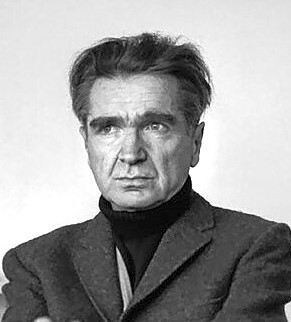
Emil Cioran (1911–1995) was a Romanian-born philosopher and essayist who settled in Paris and wrote primarily in French. Working outside conventional academic philosophy, he became known for aphoristic reflections on existence, history, civilization, suffering and human futility, expressed through a radical form of philosophical pessimism.
Cioran as a Fragmentary Precursor
Cioran presents a very different case from thinkers such as Alan Gregg, Arthur Koestler or Warren Hern.
He did not construct a systematic theory of humanity’s relationship with the biosphere. His thought proceeds through aphorisms: isolated flashes of intuition, often deliberately extreme, sometimes mutually contradictory, and not intended to form a coherent scientific or philosophical model.
For this reason, it would be misleading to present Cioran as having anticipated Cancerism as a theory.
Yet among the hundreds of aphorisms collected in The Trouble with Being Born, two formulations are strikingly close to themes that would later become central to Cancerism.
The first concerns the very appearance of Homo sapiens within nature:
“In permitting man, Nature has committed much more than a mistake in her calculations: a crime against herself.”
This brief statement contains an intuition of considerable importance.
Humanity is not described merely as an animal that behaves badly, nor as a civilization that has taken a wrong historical direction. The problem appears with man himself. Nature, by producing the human being, has generated something capable of acting against the larger system from which it emerged.
Cancerism develops this intuition in a different and more specific direction. It identifies the abnormal evolutionary development of the human brain as the decisive event that progressively gave one species the power to overcome ecological constraints and transform the biosphere on a planetary scale.
Cioran offers no such causal model. But his aphorism points toward the same paradox: nature has produced, from within itself, an organism capable of turning against nature.
Man as the Cancer of the Earth
A second aphorism is even closer to the central image of Cancerism:
“Trees are massacred, houses go up—faces, faces everywhere. Man is spreading. Man is the cancer of the earth.”
Here the correspondence is explicit.
Cioran links the destruction of vegetation, the multiplication of human constructions and the spatial expansion of humanity directly with cancer.
The power of the aphorism lies partly in its sequence.
First the trees disappear.
Then houses proliferate.
Then human faces multiply everywhere.
Finally comes the diagnosis: humanity spreads like a cancer over the Earth.
Cioran does not develop the analogy biologically. He does not examine proliferation, invasion, metastasis, resource appropriation or the relationship between malignant cells and the organism that sustains them.
The comparison remains an aphoristic intuition.
Nevertheless, it is an exceptionally clear anticipation of the image at the heart of Cancerism: human expansion as a pathological process occurring within the larger living system of the planet.
Cioran was not the first thinker in this collection to make an explicit cancer comparison. Alan Gregg had already developed a medical analogy between human population growth and malignant disease in 1954–1955.
Cioran’s importance is different.
In a few words, and entirely outside a medical or demographic argument, he expresses the same diagnosis with extraordinary force: man expands at the expense of the living Earth, and this expansion resembles cancer.
Where Cioran Diverges from Cancerism
Another aphorism in the same book reveals how far Cioran’s pessimism can move away from Cancerism.
“Nature’s great mistake was not knowing how to limit herself to a single kingdom. Compared with the vegetable, everything else seems inappropriate, out of place. The sun should have frowned at the appearance of the first insect and moved away at the irruption of the chimpanzee.”
Cioran suggests that nature’s fundamental mistake was not merely the production of humanity, but its failure to stop with the vegetable kingdom. Animal life itself appears to him as an unfortunate development, culminating symbolically in the chimpanzee.
Here the affinity ends.
Cancerism is not a rejection of life.
On the contrary, it regards the extraordinary development and diversification of life on Earth as the fundamental reality threatened by the human malignant process.
Plants, animals, microorganisms and ecosystems constitute the immensely complex biosphere within which Homo sapiens appeared and upon which Homo sapiens remains completely dependent.
The problem, from the perspective of Cancerism, is therefore not that nature produced animal life.
Nor is life itself an evolutionary mistake.
The anomaly lies in the particular trajectory followed by one species and, more specifically, in the exceptional development of the organ that gave that species unprecedented power over every other form of life.
Cioran’s third aphorism therefore illustrates both his relevance and his limits as a precursor.
His radical pessimism sometimes encompasses life itself, whereas Cancerism distinguishes between the living system and the human process that is progressively disrupting it.
Why Cioran Belongs among the Precursors
Cioran should therefore not be included among the precursors of Cancerism because he developed a coherent theory resembling it.
He did not.
He belongs here because, among a vast number of aphorisms concerned with existence, consciousness, suffering and human futility, he produced two remarkably precise intuitions:
- nature produced in humanity something capable of acting against nature itself;
- the expansion of humanity across the Earth can be compared explicitly with cancer.
These are fragments, not a system.
Cancerism attempts to do what Cioran did not: connect such isolated intuitions with evolutionary biology, the abnormal development of the human brain, population growth, resource appropriation, ecological invasion, technological expansion and the structural behaviour of malignant disease.
KEY AFFINITIES WITH CANCERISM
- Humanity as a product of nature that turns against nature
- Human expansion as an intrinsically destructive process
- Destruction of vegetation accompanying human proliferation
- Explicit identification of man with “the cancer of the earth”
- Recognition of a fundamental anomaly associated with the human condition
POINT OF DIVERGENCE
- Cioran’s pessimism can extend to animal life itself, whereas Cancerism regards life and the biosphere as the system endangered by the specifically human evolutionary anomaly.
Source: Emil Cioran, De l’inconvénient d’être né, Gallimard, Paris, 1973.
English edition: E. M. Cioran, The Trouble with Being Born, translated from the French by Richard Howard, Viking Press, New York, 1976.
