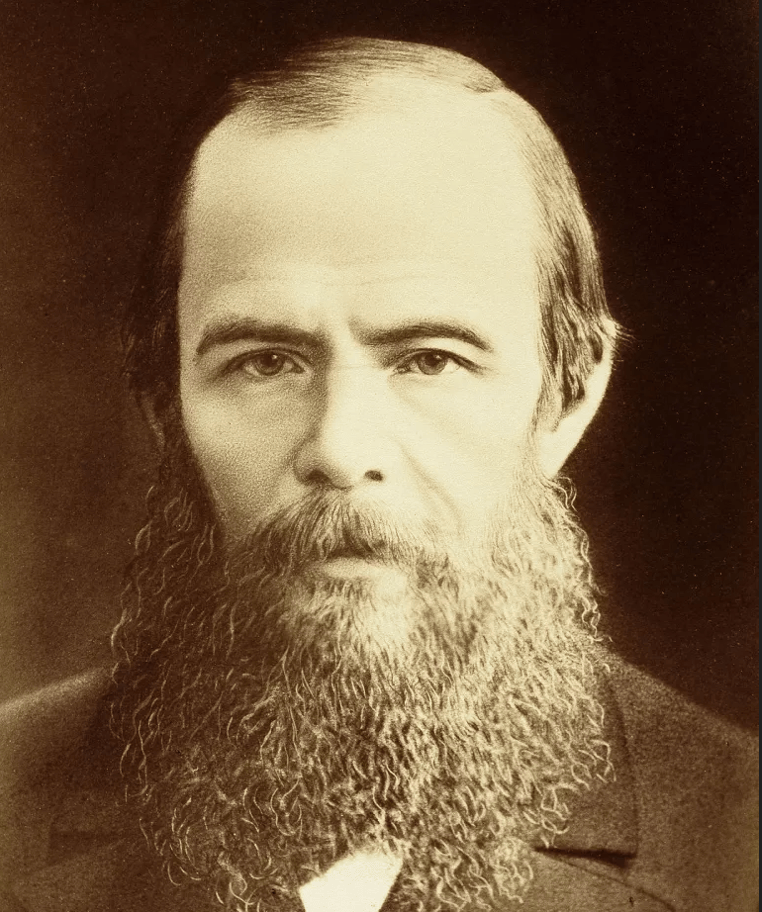
Fyodor Dostoevsky (1821–1881) was a Russian novelist and essayist whose fiction explored freedom, suffering, morality, faith and the psychological contradictions of modern humanity. Works such as Crime and Punishment, The Idiot, Demons and The Brothers Karamazov made him one of the major figures of nineteenth-century literature.
SELECTED TEXTS
From Notes from Underground (1864)
“I swear to you, gentlemen, that being conscious of too many things is an illness — a real and genuine illness. […] I am firmly convinced that not only excessive consciousness, but consciousness itself, is a disease.”
“[…] we must never tire of reminding ourselves that nature does not consult us, at any time or under any circumstances; that we must accept it as it is, and not as our imagination would like it to be […]”
“You see, gentlemen, reason is an excellent thing, there is no disputing that. But reason is only reason and satisfies only the rational faculty of man, whereas the will is an expression of the whole of life. […] It is perfectly natural that I should want to live by satisfying all my vital faculties, not merely the faculty of reason, which may represent only a twentieth part of them.
What does reason know? Reason knows only what it has succeeded in learning — and perhaps there are things it will never know. That may not be comforting, but why conceal it?”
“The respectable ants began with the anthill, and with the anthill they will undoubtedly end — which says a great deal for their perseverance and good sense.”
“[…] the goal to be attained […] can only be two times two equals four — a formula. But two times two equals four is no longer life, gentlemen; it is the beginning of death. […] I readily admit that two times two equals four is an excellent thing; but, if everything is to receive its due, two times two equals five can sometimes be a delightful little thing as well.”
“[…] in my opinion consciousness is man’s greatest misfortune; yet I know that man loves it and would not exchange it for the greatest satisfactions.”
“We are burdened even by being human — human beings with real bodies and blood of our own. We are ashamed of it, regard it as something disgraceful, and dream of becoming some unprecedented kind of abstract beings. […] Soon we shall discover a way of being born from an idea.”
Source: Fyodor Dostoevsky, Notes from Underground (Записки из подполья, 1864). English translation prepared for The Planet’s Cancer.
From The Idiot (1868–1869)
“One clear, sunny day he went up into the mountains, tormented by a vague thought that he could not grasp. Above him stretched the pure blue of the sky; below lay the lake; all around him extended the immense curve of the horizon. The Prince looked, and suffered. He stretched his arms toward the distant blue and wept. What made him weep was the feeling that he was a stranger to the celebration in which all creation was taking part.
It was an immense feast, an endless joy that attracted him and had always attracted him, yet in which he could not participate.
Every morning the clear, radiant sun rose; every morning the rainbow arched over the waterfall; every evening the highest mountain peak, at the edge of the sky, burned in the purple light of sunset. Every tiny fly buzzing around him took part in that chorus of joy: it knew its place, loved it, and was happy. Every blade of grass grew and fulfilled its life.
Everything, every living being, had a path to follow and followed it singing. Only he knew nothing and understood nothing — neither the words of men nor the voices of animals. To him alone, a stranger to everything, nature seemed like a stepmother.”
Source: Fyodor Dostoevsky, The Idiot (Идиот, 1868–1869), Part III, Chapter VII. English translation prepared for The Planet’s Cancer.
