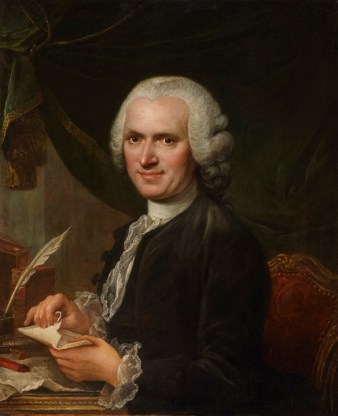
Jean-Jacques Rousseau (1712–1778) was a Genevan philosopher, writer and political thinker whose work profoundly influenced European culture and modern political thought. He questioned the conventional identification of civilization with progress and examined how social institutions, inequality and artificial needs could estrange human beings from their natural condition.
SELECTED TEXTS
From Discourse on the Sciences and Arts (1750)
“[…] our souls have become corrupted in proportion as our sciences and arts have advanced toward perfection. Will it be said that this is a misfortune peculiar to our own age? No, gentlemen: the evils caused by our vain curiosity are as old as the world.”
“Peoples, know once and for all that nature wished to preserve you from knowledge, as a mother snatches a dangerous weapon from the hands of her child; that all the secrets she conceals from you are so many evils from which she protects you, and that the difficulty you encounter in acquiring knowledge is by no means the least of her benefits. Men are wicked; they would be worse still had they had the misfortune to be born learned.”
“If our sciences are vain in the objects they pursue, they are even more dangerous in the effects they produce.”
Source: Jean-Jacques Rousseau, Discours sur les sciences et les arts. English translation from the original French prepared for The Planet’s Cancer.
From Discourse on the Origin and Foundations of Inequality Among Men (1755)
“[…] most of our ills are of our own making, and we would have avoided almost all of them by preserving the simple, uniform and solitary way of life prescribed to us by nature.
If nature intended us to be healthy, I would almost dare to assert that the state of reflection is a state contrary to nature, and that the man who meditates is a depraved animal.”
“[…] the knowledge of death and its terrors is one of the first acquisitions man made in moving away from the condition of the animals.”
“[…] what shall we say of agriculture, an art that requires so much labour and foresight; that is connected with so many other arts; that quite evidently can be practised only in a society already at least partly established; and that serves us not so much to obtain from the earth the food it would provide without it, as to force the earth to conform to the preferences that please us most?”
“However much it may have belonged to Socrates and minds of his kind to acquire virtue through reason, the human race would long ago have ceased to exist had its preservation depended only on the reasoning of its members.”
“[…] wandering through the forests, without industry, without speech, without a dwelling, without war and without association, having no need of his fellow men and no desire to harm them, perhaps without ever even recognizing any of them individually, savage man, subject to few passions and sufficient unto himself, possessed only the feelings and knowledge suited to that condition. He felt only his true needs, considered only what he believed it was in his interest to see, and his intelligence made no more progress than his vanity.”
“The new intellectual capacities that resulted from this development increased his superiority over the other animals and made him aware of it. He trained himself to set traps for them and deceived them in a thousand ways; and although many surpassed him in strength in combat or speed in running, among those that could serve or harm him, he eventually became the master of the former and the scourge of the latter.”
“In this new condition, with a simple and solitary life, very limited needs, and the tools invented to satisfy them, men enjoyed a great deal of leisure and used it to obtain various kinds of comforts unknown to their ancestors. This was the first yoke they unwittingly imposed upon themselves and the first source of the evils they prepared for their descendants.
For, besides continuing to weaken both body and mind, these comforts, having through habit almost entirely lost their pleasantness and at the same time degenerated into real needs, became far more painful to be deprived of than pleasant to possess; men were unhappy in losing them without being happy in possessing them.”
“[…] it was iron and wheat that civilized men and brought ruin upon the human race.”
Source: Jean-Jacques Rousseau, Discours sur l’origine et les fondements de l’inégalité parmi les hommes. English translation from the original French prepared for The Planet’s Cancer.
From Emile, or On Education (1762)
“Everything is good as it leaves the hands of the Author of things; everything degenerates in the hands of man. He forces one soil to nourish the products of another, one tree to bear the fruits of another; he mixes and confounds climates, elements and seasons; he mutilates his dog, his horse, his slave; he overturns everything, disfigures everything; he loves deformity and monsters; he wants nothing as nature made it, not even man himself […]”
Source: Jean-Jacques Rousseau, Émile, ou De l’éducation. English translation from the original French prepared for The Planet’s Cancer.
