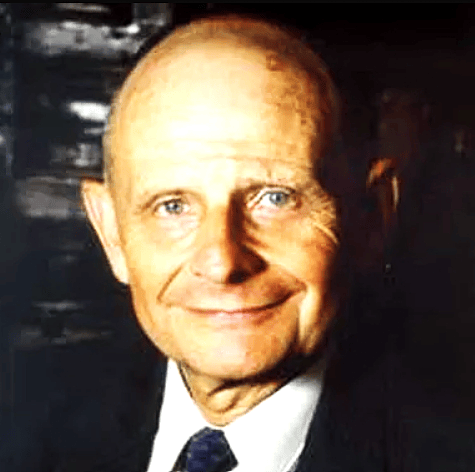
Jean Servier (1918–2000) was a French ethnologist, sociologist and specialist in the cultures and languages of the Berber peoples of North Africa. Born in Constantine, Algeria, he later taught ethnosociology at the University of Montpellier and wrote extensively on traditional societies, civilization, utopian thought and social change.
Was Jean Servier a Precursor of Cancerism?
In L’Homme et l’invisible (1964), Jean Servier makes a comparison that immediately attracts attention from the perspective of Cancerism.
He likens empire to cancer: just as cancer consists in a disorderly proliferation of cells at the expense of the harmony of the organism, empire expands at the expense of the human societies and cultures it incorporates. Even where an empire appears highly organized, Servier argues, such apparent order does not prevent it from becoming an agent of destruction.
This comparison provides a useful starting point for asking whether Servier may be regarded as one of the precursors of Cancerism.
Servier’s work is marked by a profound contrast between what he calls “traditional civilizations” and the civilization of the modern Western world.
Traditional civilizations, in his interpretation, maintained a direct relationship with the “Invisible”: the sphere of the sacred, the supernatural, and the forces believed to govern the order of the universe. Different peoples gave different forms and names to the divine, but Servier believed that throughout most of human history this relationship with the sacred imposed limits upon human conduct and helped preserve a sense of cosmic harmony.
The modern West progressively broke with that order.
Servier associated this change with the rise of empires, which he regarded as early manifestations of the will to domination later expressed on a much larger scale by Western civilization. In his interpretation, these “kingdoms of matter” weakened spiritual values and increasingly directed human life toward the acquisition of worldly goods, territorial power and material expansion.
The great empires of history eventually collapsed, leaving political, material and moral ruins behind them. Yet their logic did not disappear. Through successive transformations, Servier believed, it contributed to the formation of what became the dominant civilization of the modern world.
This is particularly interesting from the standpoint of Cancerism, because Servier again resorts to an explicitly oncological comparison when discussing modern society.
He argues that Western civilization contains within itself the seeds of a destructive process. Having turned material development into an end in itself, it progressively weakens the individuals and social structures upon which it depends, just as certain pathological processes within the body can damage the organism they should serve.
These are not isolated observations. Although Servier does not systematically develop a theory of humanity as planetary cancer, his entire analysis portrays modern Western civilization as a force capable of destroying a previously existing equilibrium.
The central word in his anthropology is harmony.
Traditional civilizations, according to Servier, understood themselves as having lost an original state of perfection. Myths of a primordial fall, which appear in many different forms, expressed an awareness that humanity no longer inhabited an original paradise. Ritual, religion and tradition were therefore ways of preserving contact with the Invisible and of maintaining an equilibrium already endangered by the original rupture.
Western civilization, by contrast, conceived history as a linear movement toward increasing mastery.
Instead of attempting to preserve an inherited equilibrium, it progressively sought to overcome limits, transform nature and extend human power.
Servier’s books contain a remarkable wealth of examples drawn from myths, rituals and traditional beliefs. He refuses to treat the peoples who hold such beliefs as merely primitive or savage. On the contrary, he sees in many of them a wisdom based on continuity, restraint and respect for an order received from earlier generations.
This immediately raises a difficult question.
If traditional civilizations really lived in greater harmony with their surroundings, why were they ultimately unable to resist the civilization that destroyed or absorbed them?
Servier himself provides part of the answer when he observes that the West chose the unlimited development of techniques without first asking whether, in making that choice, it risked losing something essential in its own humanity.
His interpretation therefore suggests a historical discontinuity.
For Servier, traditional civilizations remained integrated within an older spiritual and ecological order, whereas modern Western civilization departed from that order through an increasingly materialistic will to mastery.
It is here that Servier’s interpretation and Cancerism begin to diverge.
In highly simplified form, Servier’s position may be summarized as follows:
- traditional civilizations generally recognized some version of humanity’s fall from an original state of harmony;
- through religion, ritual and tradition, they attempted to preserve a relationship with the Invisible and with the larger order of the world;
- one particular civilization — modern Western civilization — progressively broke this balance and replaced it with material expansion, technical domination and unlimited growth;
- through imperialism, industry and technological power, this model eventually spread to the rest of humanity.
From this perspective, it would not be Homo sapiens as such that behaves like a cancerous force. The pathological element would lie primarily in a particular civilization and in the worldview that produced it.
Cancerism, by contrast, sees no fundamental discontinuity between traditional humanity and modern industrial humanity.
Human beings have always attempted to increase their control over their environment whenever circumstances and available means allowed them to do so. In this respect they followed a tendency common to living organisms: every species expands when ecological conditions permit it.
What changed radically in the human case was not the existence of this tendency, but the extraordinary means available to it.
At a certain stage of evolution, Homo sapiens developed its brain and cognitive capacities to a degree unprecedented in the history of life. Those capacities progressively enabled one species to overcome limitations that had previously constrained all others.
At first the consequences remained difficult to perceive. Forests appeared inexhaustible, animal populations immense, and the Earth effectively limitless.
But the process continued.
Agriculture, cities, empires, navigation, industrialization, fossil energy, science and technology multiplied human power until ecological transformation became planetary in scale.
From the perspective of Cancerism, therefore, modern Western civilization is not the beginning of the process. It is one of its most accelerated and spectacular phases.
Servier’s condemnation of technological and industrial civilization nevertheless brings him very close to important elements of the Cancerist diagnosis.
He clearly perceived that unlimited material expansion could destroy the larger system on which human life itself depends. He explicitly used cancer as an analogy for empire and for destructive processes within civilization. And he understood that the pursuit of power and material development could undermine the very order that made human existence possible.
His limitation, from the perspective of Cancerism, lies in his admiration for traditional civilizations.
Servier tended to regard them as evidence that human beings were capable of maintaining a fundamentally harmonious relationship with nature so long as they remained connected to tradition and the sacred.
Cancerism interprets the historical process differently.
Traditional societies may have had much smaller ecological impacts, but this does not necessarily mean that they represented a fundamentally different humanity. Their relative ecological compatibility may also have resulted from demographic, technological and energetic limitations that prevented human expansion from reaching the scale achieved by modern civilization.
Once those limitations were progressively overcome, the underlying expansionary capacity of Homo sapiens became visible on a planetary scale.
Servier himself recognized the devastating consequences of the encounter between modern Western civilization and traditional peoples. He described Western influence as something capable of destroying entire cultures through a kind of contagious process: material goods, technologies and new desires could dissolve inherited social structures even without direct military conquest.
The metaphor of contagion is significant.
The civilizations Servier admired were not simply annihilated from outside. Their descendants increasingly adopted the same material aspirations, technologies and consumption patterns that had originated in the industrial West.
The result is visible today.
The civilization once identified primarily with Europe and North America has become a global model. Industrial development, intensive resource exploitation, mass consumption and technological expansion are no longer specifically “Western” phenomena.
China, India and many other societies now participate fully in the same global process, often on a scale unimaginable when Servier first published L’Homme et l’invisible in 1964.
This historical development weakens the idea that the ecological crisis can be attributed exclusively to one civilization.
It suggests instead that once a sufficiently powerful technological and economic model becomes available, human societies of very different cultural origins tend to adopt it.
Personally, I would have preferred a history in which human beings continued to live with a much smaller ecological footprint, preserving something closer to the equilibrium admired by Servier.
But Cancerism asks why history did not follow that path.
Its answer is not primarily moral or cultural.
The decisive change occurred much earlier, when the evolutionary development of the human brain gave Homo sapiens cognitive capacities that progressively enabled it to escape the regulatory constraints imposed upon other species.
Once that process had begun, its consequences accumulated over thousands of years.
The Enlightenment, modern science, industrialization and contemporary technology were not isolated accidents. They were successive manifestations of a much older evolutionary trajectory.
For this reason, Jean Servier deserves a place among the precursors and contributors to Cancerism.
He did not identify Homo sapiens itself with the planetary malignancy described by Cancerism. He located the destructive process mainly within modern Western civilization.
But he recognized with remarkable clarity several elements that would later become central to the Cancerist framework: uncontrolled expansion, the destructive logic of empire, the destabilizing effects of technological power, the dissolution of ecological and cultural limits, and — most strikingly — the analogy between pathological cellular proliferation and destructive forms of human organization.
KEY AFFINITIES WITH CANCERISM
- Empire compared with cancer
- Disorderly proliferation at the expense of the whole
- Destruction of an earlier equilibrium
- Unlimited technological development
- Material expansion as an end in itself
- Loss of ecological and cultural limits
- Civilization as a self-destructive process
- Global diffusion of a destructive model
Source discussed: Jean Servier, L’Homme et l’invisible, Robert Laffont, Paris, 1964.
