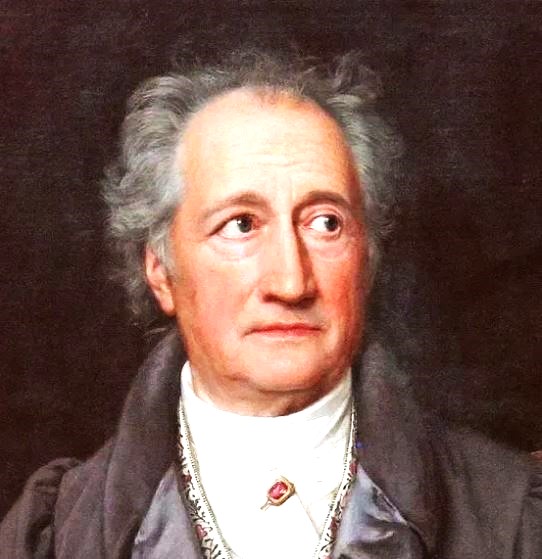
Johann Wolfgang von Goethe (1749–1832) was a German poet, novelist, dramatist, statesman and natural scientist. Best known for Faust, he also pursued extensive studies of botany, morphology, optics and the processes of transformation in nature. His work repeatedly explored the relationship between human activity, knowledge and the larger natural order.
SELECTED TEXTS
From Faust, Part One — Prologue in Heaven
MEPHISTOPHELES:
“The little God o’ the world jogs on the same old way
And is as singular as on the world’s first day.
A pity ’tis thou shouldst have given
The fool, to make him worse, a gleam of light from heaven;
He calls it reason, using it
To be more beast than ever beast was yet.”
Source: Johann Wolfgang von Goethe, Faust, Part One, “Prologue in Heaven” (1808). English translation by Bayard Taylor, Faust: A Tragedy (1870), public domain.
From Faust, Part One — Night
FAUST:
“Have now, alas! quite studied through
Philosophy and Medicine,
And Law, and ah! Theology, too,
With hot desire the truth to win!
And here, at last, I stand, poor fool!
As wise as when I entered school;
Am called Magister, Doctor, indeed,—
Ten livelong years cease not to lead
Backward and forward, to and fro,
My scholars by the nose—and lo!
Just nothing, I see, is the sum of our learning,
To the very core of my heart ’tis burning.”
Source: Johann Wolfgang von Goethe, Faust, Part One, “Night” (1808). English translation by Bayard Taylor, Faust: A Tragedy (1870), public domain.
From Faust, Part One — Martha’s Garden
FAUST:
“Sweet face, do not misunderstand my thought!
Who dares express him?
And who confess him,
Saying, I do believe?
A man’s heart bearing,
What man has the daring
To say: I acknowledge him not?
The All-enfolder,
The All-upholder,
Enfolds, upholds He not
Thee, me, Himself?
Upsprings not Heaven’s blue arch high o’er thee?
Underneath thee does not earth stand fast?
See’st thou not, nightly climbing,
Tenderly glancing eternal stars?
Am I not gazing eye to eye on thee?
Through brain and bosom
Throngs not all life to thee,
Weaving in everlasting mystery
Obscurely, clearly, on all sides of thee?
Fill with it, to its utmost stretch, thy breast,
And in the consciousness when thou art wholly blest,
Then call it what thou wilt,
Joy! Heart! Love! God!
I have no name to give it!
All comes at last to feeling;
Name is but sound and smoke,
Beclouding Heaven’s warm glow.”
Source: Johann Wolfgang von Goethe, Faust, Part One, “Martha’s Garden” (1808). English translation by Bayard Taylor, Faust: A Tragedy (1870), public domain.
