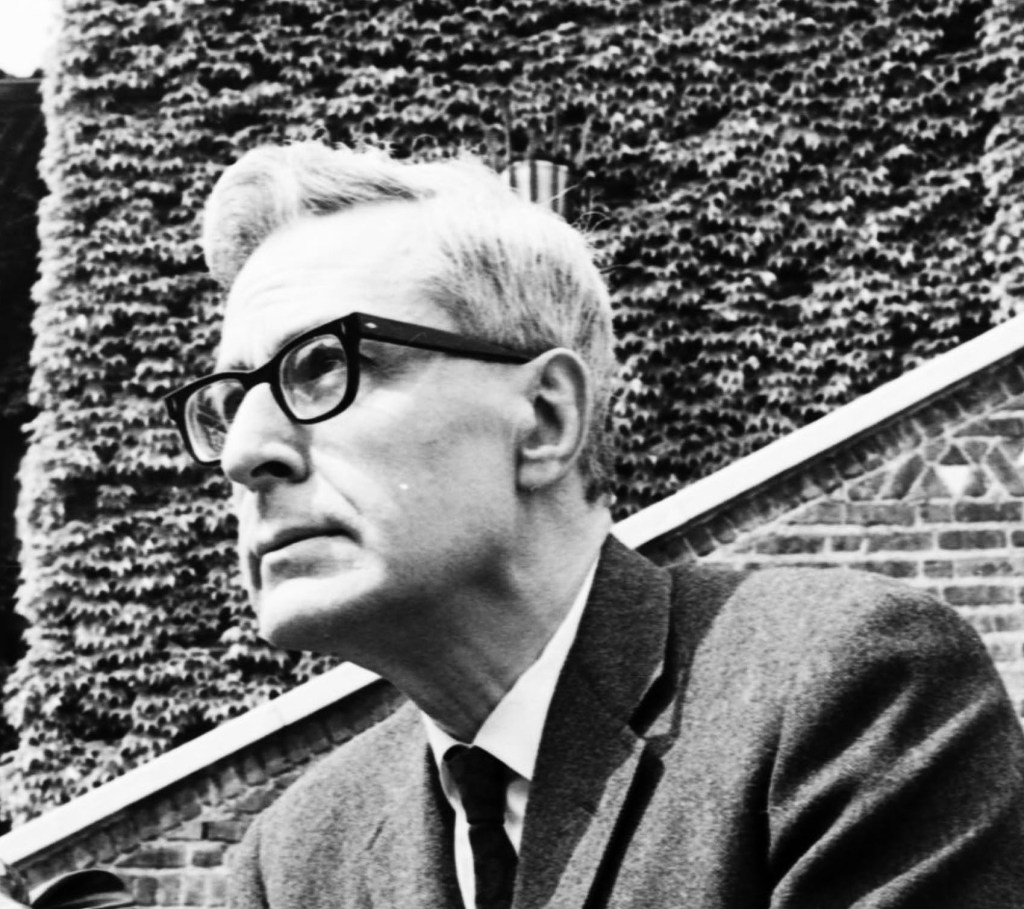
Loren Eiseley (1907–1977) was an American anthropologist, evolutionary thinker and science writer. He earned his PhD in anthropology at the University of Pennsylvania, where he later became Professor of Anthropology and History of Science and served as Provost. His essays combined evolutionary science, philosophy and a sustained reflection on humanity’s relationship with the natural world.
The Emergence of Mind
In a 1962 television conversation devoted to humanity and the environment, Loren Eiseley reflected on the appearance of Homo sapiens as an extraordinary evolutionary event.
For Eiseley, the emergence of humanity introduced something unprecedented into the history of life: the realm of mind.
Other organisms had occupied the seas, the continents and the air. Human beings, however, entered another domain — a mental world in which things could be imagined and created that did not previously exist in nature.
This capacity opened immense possibilities, but it also introduced a new danger.
The human mind could construct an increasingly artificial environment and progressively distance humanity from the natural system from which it had emerged.
The Danger of the Mind
Eiseley emphasized that human beings remain biologically dependent on the natural world even when their technological environment conceals that dependence.
The mind makes it possible to rearrange matter, build machines, transform landscapes and accelerate change at a pace without precedent in biological evolution.
Yet the same capacity can create the illusion that humanity has escaped nature.
For Eiseley, this is precisely where the danger lies.
The mind can construct a world so artificial that human beings forget that their survival still depends upon the larger community of life.
Humanity as a Planetary Disease
During the conversation, the interviewer suggested that Eiseley’s position could be summarized by saying that man might be conceived as a “planetary disease.”
Eiseley accepted the formulation in qualified terms.
Any organism, he argued, can become dangerous when it temporarily escapes the ecological relationships that normally regulate it.
Humanity had acquired precisely this possibility.
Seen from above, expanding urban concentrations, disappearing forests and spreading highways could resemble a pathological process extending across the surface of the Earth.
Escaping the Living Web
The concept of the “living web” is central to Eiseley’s argument.
Every organism exists within networks of ecological dependence that constrain its behaviour and connect it with other forms of life.
Humanity is no exception.
But technological intelligence has given Homo sapiens an unusual ability to weaken, postpone or bypass some of those constraints.
This temporary escape from regulation is one of Eiseley’s most important insights.
An organism that becomes detached from the system that normally limits it may expand beyond the conditions compatible with the stability of that system.
The Asphalt Man
Eiseley used the expression “asphalt man” for the increasingly urban human being who has lost direct awareness of the natural world.
Such a person may come to believe that science and technology can replace other forms of life altogether.
For Eiseley, this belief represents a profound misunderstanding.
Humanity cannot eliminate the rest of the biosphere and simply continue inside an artificial technological environment.
Human beings remain part of the same ecological network as microorganisms, plants and animals, however successfully civilization may conceal that dependence.
Expansion at the Expense of Other Life
Eiseley also interpreted human history as a progressive appropriation of the productivity of other organisms and ecosystems.
Early humans expanded through hunting and the exploitation of large mammals.
Fire increased their capacity to alter landscapes.
Agriculture subsequently made much larger and denser populations possible.
Stored food, transport systems and technological organization eventually supported the enormous urban concentrations of modern civilization.
At every stage, human expansion depended upon increasing appropriation of energy and biological resources from the surrounding living world.
The Artificial Environment
Modern civilization therefore creates a paradox.
The more successful humanity becomes at constructing its own environment, the easier it becomes to forget the natural foundations upon which that artificial environment depends.
Cities can sustain enormous populations only because extensive systems transport food, energy and materials from distant regions.
Technology does not abolish ecological dependence.
It extends it geographically and conceals it psychologically.
This distinction is highly relevant to Cancerism: apparent independence from natural limits may actually represent a more extensive appropriation of the host system.
Where Eiseley and Cancerism Converge
The convergence with Cancerism is significant.
Eiseley views humanity as an organism capable of escaping, at least temporarily, the ecological network that normally regulates living populations.
He describes human expansion as potentially pathological at the planetary scale.
Most importantly, he connects this transformation with the emergence of the human mind.
The same evolutionary novelty that made civilization, technology and artificial environments possible also created the danger of separating humanity from the ecological system upon which it remains dependent.
Cancerism develops this intuition into a more explicit causal theory.
It identifies the abnormal evolutionary development of the human brain as the decisive transformation that enabled Homo sapiens progressively to evade ecological constraints and acquire unprecedented power over the biosphere.
Where Eiseley Stops
Eiseley does not construct an oncological model of humanity.
He does not systematically compare human behaviour with proliferation, invasion, metastasis, resource appropriation or the other biological characteristics of malignant disease.
Nor does he describe the evolution of the human brain itself as an abnormal biological process.
His contribution is different.
He identifies the human mind as an unprecedented evolutionary development, recognizes that it allows humanity to escape the “living web,” and accepts the possibility of understanding the resulting expansion as a planetary disease.
Why Eiseley Belongs among the Precursors
Eiseley belongs among the important precursors of Cancerism because he connects three ideas that rarely appear together so early:
- the emergence of the human mind as a radically new evolutionary event;
- humanity’s capacity to escape ecological regulation;
- the possibility of interpreting human expansion as a planetary disease.
His analysis does not amount to Cancerism.
But it approaches one of its deepest questions: what happened in human evolution that enabled one species to break through the regulatory relationships of the biosphere and transform the planet on an unprecedented scale?
KEY AFFINITIES WITH CANCERISM
- Humanity conceived as a possible “planetary disease”
- The human mind treated as an unprecedented evolutionary development
- Intelligence enabling the creation of an artificial environment
- Humanity temporarily escaping the ecological constraints of the “living web”
- Urban expansion associated with the disappearance of forests and natural systems
- Technology concealing rather than eliminating ecological dependence
- Human expansion occurring at the expense of other forms of life
- Agriculture and technology enabling increasing population concentration
- Recognition that breaking ecological constraints can ultimately threaten humanity itself
POINT OF DIVERGENCE
- Eiseley identifies the emergence of mind as both a source of danger and a potential instrument of understanding, but he does not develop a systematic theory of humanity as malignant disease or describe the evolutionary development of the human brain itself as pathological. Cancerism makes that evolutionary abnormality its central causal hypothesis.
Source
Loren Eiseley, interview in The House We Live In, Episode 12, National Educational Television, 1962. Preserved by the American Archive of Public Broadcasting, a collaboration between the Library of Congress and GBH.
