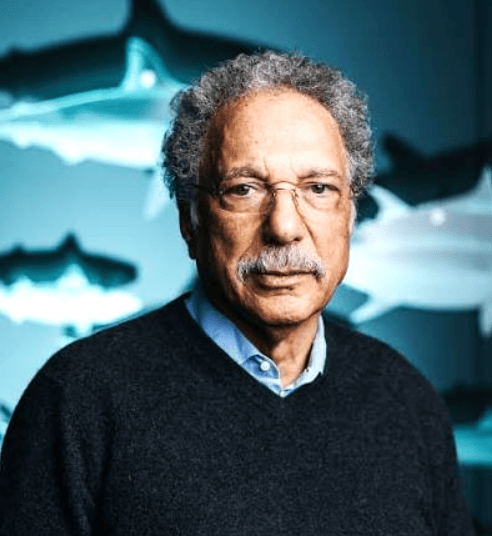
Daniel Pauly (born 1946) is a French-Canadian fisheries scientist and professor at the University of British Columbia. He is internationally known for research on global fisheries, marine ecosystems, “shifting baselines” and the ecological effects of industrial fishing, and is the founder and principal investigator of the Sea Around Us initiative.
From Ecosystem Member to Ecological Malignancy
In his 2014 essay Homo sapiens: cancer or parasite?, fisheries scientist Daniel Pauly examines two conflicting ways of understanding humanity’s ecological role.
The first is the reassuring idea that humans are simply “part of the ecosystem.”
The second is far more disturbing: Homo sapiens has become a cancer on the Earth.
Pauly argues that human history makes the first interpretation increasingly difficult to sustain.
When Humans Were Part of the Ecosystem
Pauly begins by distinguishing modern humanity from its distant ancestors.
Early human populations were still subjected to the same ecological controls as other animals.
Predators could kill humans.
Food availability restricted population size.
Human numbers therefore remained constrained by the carrying capacity of their environment.
In ecological terms, humanity was controlled both from above, by predators, and from below, by available resources.
Homo sapiens was genuinely embedded within ecosystem dynamics.
Escaping Ecological Control
At some point, however, this relationship changed.
Pauly attributes the transition to characteristics acquired through biological and/or cultural evolution, including language, collective cooperation and increasingly effective weapons.
These innovations allowed humans to defend themselves against predators, eliminate competitors and increase their population beyond the previous ecological limits.
This is one of Pauly’s strongest affinities with Cancerism.
The decisive transition occurs when one component of the ecological system acquires the capacity to evade the controls that had previously regulated it.
Expansion Beyond the Original Habitat
Once those controls weakened, human populations expanded geographically.
Pauly follows this expansion out of Africa and across the planet.
Where humans arrived, large predators and prey species frequently disappeared, vegetation was transformed, fire altered landscapes and later agriculture intensified environmental modification.
Expansion was therefore not merely demographic.
It progressively reorganized ecosystems around the requirements of a single species.
Agriculture and the Creation of Alternative Systems
Agriculture represented a further step away from ordinary ecological regulation.
Humans began modifying plants and animals to serve their own requirements.
Instead of adapting themselves to naturally existing cycles, they increasingly constructed alternative systems designed primarily to sustain human populations.
Pauly emphasizes the significance of this reversal.
Humans still depended physically on nature, but they progressively created artificial cycles whose purpose was to serve themselves rather than the larger ecosystem.
The Economy Outside Nature’s Controls
Industrialization greatly accelerated this process.
Fossil energy, fertilizers, sanitation, medicine and antibiotics helped humanity escape still more biological and ecological constraints.
The resulting system eventually became what Pauly calls “The Economy.”
It operates physically inside nature, because nothing can exist outside the biosphere, but its internal rules are not those of natural ecosystems.
Its interaction with those ecosystems is increasingly destructive.
For Pauly, very little of nature now remains untouched by the human enterprise.
Are We a Cancer?
Pauly then makes the comparison explicit.
Nature can be imagined as the body.
Species function as different cell types.
Ecological processes provide regulatory mechanisms that maintain a form of homeostasis.
Within this system, Homo sapiens resembles one cell type that has succeeded in escaping regulation.
It proliferates.
It appropriates other components of the system as substrates.
And its expansion progressively disrupts the organization of the larger whole.
The similarity to cancer, Pauly observes, is extraordinarily close.
Analogies — or Homologies?
Pauly makes an especially significant observation when discussing earlier literature on humanity as cancer.
The parallels between the growth of civilization and the global economy, on one side, and malignant tumors on the other, are so detailed that he asks whether they should even be regarded merely as analogies — or perhaps as homologies.
This question is highly relevant to Cancerism.
The comparison is no longer being used simply as a rhetorical image.
It raises the possibility that similar systemic dynamics may occur at radically different biological and ecological scales.
One Cell Type Escapes Regulation
Pauly’s formulation comes particularly close to the Cancerist model when he describes Homo sapiens as one “cell type” that, through crucial changes, succeeded in escaping controls and proliferating.
This is structurally similar to malignant transformation.
A normal cell belongs to a regulated tissue.
Its reproduction is constrained by the requirements of the larger organism.
A malignant cell escapes those constraints and begins pursuing its own proliferation.
Pauly describes humanity in closely comparable terms.
The difference lies mainly in what he identifies as the decisive mechanism of escape.
The Economy Becomes More Virulent
Pauly extends the cancer comparison to the modern economy.
Cancer becomes progressively more virulent as disease advances.
He argues that contemporary economic systems display a comparable tendency.
Increasing emphasis on rapid and exceptionally high financial returns places pressure on ecological systems whose biological productivity proceeds at much slower rates.
Forests cannot regenerate at the speed demanded by financial speculation.
Fish populations cannot reproduce rapidly enough to satisfy indefinitely expanding extraction.
When economic expectations exceed biological renewal, natural capital itself is liquidated.
Short-Term Profit Against Ecological Time
This produces an important conflict between two temporal systems.
Natural ecosystems regenerate according to biological rates.
Financial systems increasingly demand returns over much shorter periods.
The result is structurally destructive.
Forests are cut faster than they regrow.
Fish populations are harvested faster than they reproduce.
Assets accumulated over long periods are consumed to satisfy immediate economic demands.
Pauly therefore identifies short-term economic logic as an accelerator of the malignant process.
Cancer or Parasite?
Yet Pauly does not end by simply declaring humanity to be cancer.
He introduces another biological model: parasitism.
A highly virulent parasite that rapidly kills its host undermines its own survival.
Over evolutionary time, host and parasite may instead develop a relationship in which both can continue to exist.
Some parasites can even move toward symbiosis.
Pauly therefore asks whether humanity might eventually become something comparable to a benign, co-evolved parasite of Earth’s systems.
A Possible Evolution Away from Malignancy
This possibility marks an important difference from the strict cancer model.
Cancer cells generally do not evolve toward coexistence with the organism they are destroying.
Their proliferation ends with the death of the host and therefore their own destruction.
A successful parasite, by contrast, must preserve enough of its host to maintain its own existence.
Pauly’s question is consequently whether humanity can transform its ecological relationship before the malignant process becomes terminal.
Where Pauly and Cancerism Converge
The convergence is exceptionally strong.
Both approaches begin from humanity’s original integration within natural ecological controls.
Both identify a subsequent escape from those controls.
Both connect that escape with uniquely human evolutionary and cultural capacities.
Both describe demographic expansion and geographical spread.
Both see human civilization as increasingly constructing systems designed for itself rather than participating in the regulatory cycles of the biosphere.
Both compare Homo sapiens with a cell type that has escaped regulation and begun to proliferate at the expense of the larger system.
And both recognize that the modern economy intensifies this process through continual expansion and resource appropriation.
Where the Explanations Separate
Pauly identifies several crucial innovations — language, collective action, weapons, agriculture, industrialization — that progressively freed humanity from ecological control.
Cancerism pushes the causal explanation further back.
These innovations are consequences of the abnormal evolutionary development of the human brain.
Language, technology, organized cooperation, agriculture and industrial civilization are successive manifestations of a cognitive capacity that enabled Homo sapiens to oppose constraints that regulate other species.
Pauly describes much of the mechanism with remarkable clarity, but he does not formulate the evolutionary enlargement of the human brain itself as the primary carcinogenic event.
The Question of the Parasite
There is also a second important divergence.
Pauly leaves open the possibility that humanity could cease behaving like a malignant tumor and become a relatively benign parasite capable of long-term coexistence with Earth’s ecosystems.
Cancerism is more skeptical about such a transformation because the mechanisms producing continued expansion are rooted deeply in the evolutionary characteristics of Homo sapiens.
The issue is therefore not simply whether humanity can choose a less destructive economic system.
It is whether the species can permanently restrain the capacities and drives that enabled it to escape ecological regulation in the first place.
Why Pauly Belongs among the Precursors
Pauly is one of the clearest scientific precursors of Cancerism because he goes beyond a superficial cancer metaphor.
He reconstructs a historical transition from ecological integration to ecological escape.
He describes Homo sapiens as a formerly regulated component of ecosystems that acquired the ability to escape controls, proliferate, expand geographically and use other components of the biosphere as substrates.
He explicitly compares this process with malignant transformation.
He recognizes the extraordinarily close correspondence between cancer growth and the expansion of civilization and the global economy.
And he asks whether the relationship may involve something deeper than metaphor alone.
His proposed alternative — humanity evolving toward benign parasitism — differs from Cancerism’s diagnosis, but it does not weaken the importance of the analysis that precedes it.
KEY AFFINITIES WITH CANCERISM
- Humanity originally regulated by ordinary ecological constraints
- Escape from predator control and environmental carrying capacity
- Biological and cultural evolution enabling that escape
- Population growth following the weakening of ecological regulation
- Expansion across the planet accompanied by ecological destruction
- Agriculture interpreted as a further step outside natural ecological cycles
- Industrialization and technology progressively reducing natural constraints
- The human economy functioning according to rules increasingly separated from ecosystem regulation
- Homo sapiens described as a “cell type” that escaped control and proliferated
- Other species and ecological systems increasingly used as substrates for human expansion
- Explicit comparison between human civilization and malignant tumor growth
- Recognition of exceptionally close structural correspondences between the two processes
- Modern economic growth interpreted as increasingly virulent
- Short-term economic demands conflicting with biological rates of regeneration
POINT OF DIVERGENCE
- Pauly identifies language, collective cooperation, technology and successive cultural developments as mechanisms through which humanity escaped ecological regulation, but he does not identify the abnormal evolutionary development of the human brain itself as the primary cause of the process. Moreover, he leaves open the possibility that Homo sapiens might evolve from a cancer-like relationship with Earth toward a relatively benign form of parasitism or symbiosis. Cancerism locates the origin of the malignancy deeper in human biological evolution and is more skeptical that the species can permanently escape the dynamics generated by that evolutionary transformation.
Source
Daniel Pauly, “Homo sapiens: cancer or parasite?”, Ethics in Science and Environmental Politics, Vol. 14, 2014, pp. 7–10. DOI: 10.3354/esep00152. Published online 27 October 2014.
