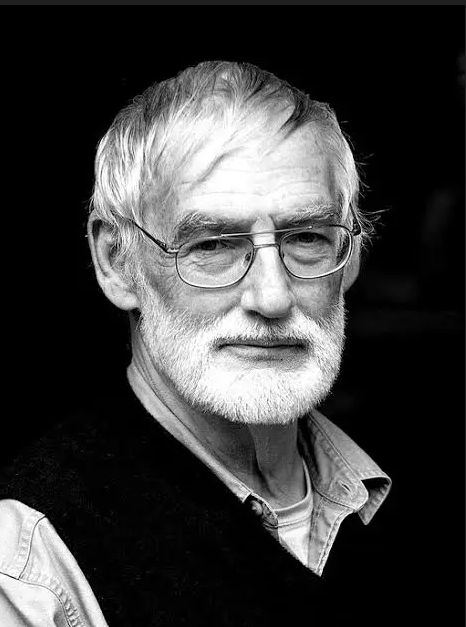
Dennis L. Meadows (born 1942) is an American systems scientist best known for directing the MIT research team that produced The Limits to Growth for the Club of Rome in 1972. Using system-dynamics modelling, the project examined interactions among population, industrial growth, food production, resource depletion and pollution on a finite planet.
Growth as Cancer
Forty years after the publication of The Limits to Growth, Dennis Meadows returned in 2012 to the central problem that had occupied his research for decades: unlimited physical growth cannot continue on a finite planet.
In an interview with the Austrian magazine FORMAT, however, he expressed the problem through an explicitly medical analogy.
Climate change, famine, financial crises and other global disorders, he argued, should not be mistaken for the underlying disease.
They are symptoms.
The deeper problem is growth itself.
The Disease Behind the Symptoms
Meadows asks us to imagine a patient suffering from cancer.
The cancer produces fever, headaches and other painful symptoms. Treating those symptoms may provide temporary relief, but it does not cure the disease.
He applies the same reasoning to the planetary crisis.
Climate change, hunger and other environmental disruptions are symptoms of a deeper systemic disorder.
If attention remains focused only on each individual symptom, the underlying process continues.
For Meadows, that process is uncontrolled growth.
Healthy Cells Know When to Stop
When the interviewer explicitly asks whether cancer is being used as a metaphor for uncontrolled growth, Meadows answers affirmatively.
Healthy cells stop growing when they reach appropriate limits.
Cancer cells do not.
They continue proliferating until their growth threatens the organism itself.
Meadows then makes the parallel explicit: population growth and economic growth behave in the same way.
The comparison is important because it shifts the problem from particular environmental impacts to the logic that continually generates them.
Population and Economic Growth
Meadows refuses to separate demographic expansion from economic expansion.
A larger population requires more food, energy, infrastructure and material resources.
At the same time, rising standards of living increase consumption per person.
The ecological burden therefore results from several interacting factors: population, consumption, energy intensity and dependence on fossil fuels.
Technical efficiency can reduce some impacts, but Meadows argues that such improvements cannot compensate indefinitely for continued increases in population and consumption.
The underlying growth dynamic remains.
A Finite Planet
This argument continues the systems analysis developed in The Limits to Growth.
A finite physical system necessarily imposes limits upon material expansion.
Growth can stop in two fundamentally different ways.
Human societies can anticipate those limits and deliberately change their behaviour.
Or physical and ecological constraints can eventually impose the adjustment.
By 2012 Meadows had become deeply pessimistic about the first possibility.
He believed that humanity had largely failed to use the decades during which deliberate limitation might have been possible.
The Planet Will Choose
Meadows expresses this point with unusual severity.
If humanity does not reduce its growth voluntarily, the larger system will ultimately impose limits through scarcity, ecological disruption and rising mortality.
The phrase “the planet will choose” summarizes this shift.
Human intention does not abolish biophysical constraints.
It can only determine whether adjustment occurs deliberately or through crisis.
This is strongly compatible with the Cancerist view that a proliferating process cannot indefinitely escape the limits of the host system on which it depends.
Why Technology Is Not Enough
Meadows is equally skeptical of technological optimism.
Renewable energy, improved efficiency and new technologies may be useful, but technology is only a tool.
If the values and objectives directing its use remain unchanged, technological innovation will continue serving the same underlying goals of expansion and consumption.
Greater efficiency can therefore fail to solve the problem if its benefits are absorbed by further growth.
The crucial issue is not simply the quality of the tools.
It is the behaviour of the species using them.
The Tragedy of the Commons
Meadows also invokes the tragedy of the commons.
When individuals benefit from increasing their own use of a shared resource, while the costs are distributed across the whole community, rational behaviour at the individual level can produce collective destruction.
The pasture is profitable for each herder as long as more livestock can be added.
But if everyone follows the same logic, the pasture is eventually destroyed.
This mechanism parallels an important aspect of malignant growth.
Local advantage can become systemic catastrophe.
Human Nature as the Deeper Problem
Near the end of the interview, Meadows moves beyond economics, institutions and technology.
Asked what would really have to change, he answers that human nature itself would have to change.
Human beings, he argues, remain adapted to circumstances in which immediate survival mattered far more than consequences occurring decades into the future.
He therefore raises the possibility that, for genetic reasons, Homo sapiens may simply be poorly equipped to deal with long-term global problems such as climate change.
This is one of the most important points of contact with Cancerism.
The failure is no longer attributed merely to defective political institutions or economic systems.
The problem may lie in the biological characteristics of the human animal itself.
Short-Term Intelligence
Meadows does not deny human intelligence.
His argument is more troubling: intelligence may be extraordinarily effective at solving immediate problems while remaining poorly suited to perceiving and governing their long-term systemic consequences.
Human beings can invent technologies, increase food production, extract new resources and overcome short-term constraints.
But each apparent solution can permit further population and economic growth, thereby intensifying the larger problem.
Intelligence can therefore postpone limits without eliminating them.
From the perspective of Cancerism, this is a crucial paradox: the same cognitive capacity that enables Homo sapiens to escape immediate constraints can amplify the long-term malignant process.
The Planet Does Not Need Saving
Meadows also makes an important distinction between the planet and humanity.
The Earth, he argues, does not ultimately need humans to “save” it.
Planetary systems have recovered from enormous disruptions before and may do so again, even if recovery requires millions of years.
What is genuinely endangered is the human species and the civilization it has constructed.
This observation removes another anthropocentric illusion: the idea that humanity somehow stands outside the planetary system as its guardian.
Humanity itself is vulnerable to the consequences of the process it has created.
Where Meadows and Cancerism Converge
The convergence is considerable.
Both approaches reject unlimited growth within a finite biosphere.
Both interpret population and economic expansion as manifestations of a systemic process rather than isolated problems.
Both use cancer to distinguish between regulated growth and proliferation that continues until it damages the larger system.
Both regard technological solutions as inadequate if the underlying dynamics remain unchanged.
Most importantly, Meadows ultimately locates part of the problem in human nature itself and raises the possibility that biological inheritance makes Homo sapiens poorly equipped to govern long-term planetary consequences.
Where Meadows Stops
Meadows nevertheless uses cancer primarily as a model of uncontrolled growth.
He does not construct the broader oncological comparison developed by Hern, Forencich or MacDougall.
He does not systematically analyze invasion, metastasis, de-differentiation, resource appropriation or evasion of regulatory mechanisms as biological parallels between cancer and human civilization.
Nor does he identify the abnormal evolutionary development of the human brain itself as the origin of the process.
His diagnosis approaches that level when he questions whether humans are genetically suited to long-term thinking, but he does not develop this into an evolutionary theory of planetary malignancy.
Why Meadows Belongs among the Precursors
Meadows belongs among the important precursors of Cancerism for two connected reasons.
First, he explicitly compares population and economic growth with cancer-cell proliferation and treats major environmental crises as symptoms of a deeper planetary disease.
Second, he eventually moves beyond economic and technological explanations and questions whether the inability to respond adequately to global crises may be rooted in human nature itself.
The combination is especially significant.
The problem is simultaneously systemic and biological.
Humanity has created a civilization based on continual expansion, yet the psychological and evolutionary characteristics of Homo sapiens may prevent it from responding adequately to the long-term consequences of that expansion.
KEY AFFINITIES WITH CANCERISM
- Explicit comparison between cancer-cell proliferation and human growth
- Healthy growth distinguished from uncontrolled malignant growth
- Population growth and economic growth treated as manifestations of the same systemic problem
- Climate change and famine interpreted as symptoms rather than the underlying disease
- Recognition that infinite physical growth is impossible on a finite planet
- Technological solutions considered inadequate when the underlying growth dynamic remains unchanged
- Individual short-term advantage capable of producing collective destruction
- Human behaviour understood as constrained by inherited biological characteristics
- Homo sapiens possibly poorly adapted to long-term planetary problems
- Intelligence capable of overcoming immediate limits while worsening long-term systemic instability
- Recognition that the planetary system will ultimately impose limits if humanity does not
POINT OF DIVERGENCE
- Meadows uses cancer primarily as a model for uncontrolled demographic and economic growth and suggests that human short-termism may have genetic roots. Cancerism extends the diagnosis to a broader structural comparison with malignant disease and identifies the abnormal evolutionary development of the human brain as the primary cause that enabled Homo sapiens to escape ecological constraints and acquire planetary power.
Source
Dennis Meadows, interview by Rainer Himmelfreundpointner, “Da ist nichts, was wir tun könnten” (“There Is Nothing We Can Do”), FORMAT, No. 22, 2012. Interview conducted during Meadows’s visit to Vienna; published 3 June 2012.
Comparative background: Donella H. Meadows, Dennis L. Meadows, Jørgen Randers and William W. Behrens III, The Limits to Growth, Universe Books, 1972.
