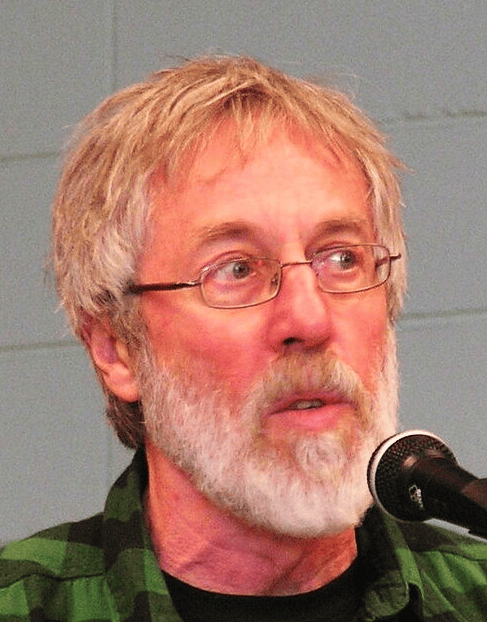
John Zerzan (born 1943) is an American writer and anti-civilization theorist associated with anarcho-primitivism. His work offers a radical critique of domestication, agriculture, technology, symbolic culture and mass society. He argues that many of the defining institutions of civilization represent a historical departure from the more egalitarian and ecologically integrated forms of life that characterized most of human existence.
Civilization as Pathology
John Zerzan’s importance for Cancerism lies not in an explicit comparison between humanity and cancer, but in his diagnosis of civilization as a pathological process.
For Zerzan, the ecological and social crises of the modern world are not accidental failures of an otherwise healthy civilization.
They arise from civilization itself.
Domestication, agriculture, division of labor, technological development and increasingly complex systems of control progressively separate human beings from the natural world and from one another.
The destruction of the biosphere is therefore not an unfortunate side effect of progress.
It is connected to the fundamental trajectory of civilization.
Before Civilization
A central element of Zerzan’s thought is his rejection of the conventional narrative according to which human history represents a continuous ascent from primitive misery toward civilization.
Drawing on archaeological and anthropological research, he emphasizes that human beings lived for an immense period before agriculture in relatively small, mobile communities.
He associates this period with greater egalitarianism, less organized violence, less intensive labor and a more direct relationship with the natural world.
Civilization is therefore not the inevitable fulfillment of human potential.
It represents, in Zerzan’s interpretation, a historical rupture.
Domestication as the Turning Point
For Zerzan, the decisive transition is domestication.
The domestication of plants and animals introduced a new relationship based on control, manipulation and appropriation.
Agriculture transformed land into property, encouraged population growth, intensified division of labor and provided the material basis for hierarchy, organized power and increasingly large settlements.
This dynamic later expanded far beyond agriculture.
The logic of domestication progressively incorporated human beings themselves.
The same impulse to control nature produced increasingly controlled social systems.
Agriculture and Population Growth
Zerzan also links agriculture to the demographic problem.
Agriculture made possible much larger and denser populations than hunting and gathering.
For him, population expansion was not simply the cause of agriculture; it was also one of its consequences.
The system thus acquired a self-reinforcing character.
Greater food production permitted more people.
More people increased dependence on agricultural production.
The resulting societies became progressively more difficult to abandon.
In this respect, Zerzan identifies a feedback mechanism that is highly relevant to Cancerism: successful expansion creates the conditions for still further expansion.
Technology and the Domination of Nature
Zerzan’s critique becomes still more radical when he turns to technology.
Technology is not, in his view, merely a neutral collection of tools that can be used for good or evil.
Advanced technological systems embody division of labor, specialization, control and dependence.
As civilization develops, technology increases humanity’s ability to reorganize the natural environment around human needs.
The result is an ever deeper penetration and transformation of the biosphere.
What is conventionally celebrated as technological progress can therefore also be understood as an increasing capacity to dominate nature.
The Destruction of the Biosphere
For Zerzan, the present ecological crisis is the culmination of this long trajectory.
Industrial civilization consumes landscapes, species and resources while simultaneously producing pollution, alienation and dependence on increasingly complex technological systems.
The health of the biosphere declines as the reach of civilization expands.
This is one of the strongest affinities with Cancerism.
Both perspectives refuse to interpret environmental destruction as a collection of isolated problems.
Deforestation, extinction, pollution, resource depletion and climate disruption are manifestations of a larger process.
Symbolic Culture
Zerzan goes further than many critics of industrial civilization by questioning symbolic culture itself.
Language, number, time, representation and other symbolic systems are, in his interpretation, part of a gradual separation between direct experience and an increasingly mediated human world.
He therefore traces the roots of civilization deeper than agriculture alone.
The progressive replacement of immediate participation in nature by representation, abstraction and control prepares the way for domestication and technological society.
This aspect of his thought makes his critique much more radical than ordinary environmentalism.
A Fundamental Difference over Intelligence
Here, however, Zerzan diverges sharply from Cancerism.
He explicitly rejects the idea that civilization arose because humans suddenly became more intelligent.
Zerzan points to evidence that humans possessed cognitive abilities comparable to ours long before agriculture and civilization appeared.
For hundreds of thousands of years, he argues, humans had sufficient intelligence to create highly complex technological and social systems but did not do so.
Intelligence itself therefore cannot explain civilization.
For Zerzan, the decisive historical developments are symbolic culture, division of labor and domestication.
Cancerism takes a different view.
It places the abnormal evolutionary development of the human brain at the deepest level of the causal process.
The fact that destructive civilization emerged only much later does not, from the Cancerist perspective, remove the brain from the causal chain. It means that the extraordinary capacities created by brain evolution required historical conditions through which their planetary consequences could progressively unfold.
Historical Rupture or Evolutionary Anomaly?
The distinction can therefore be stated clearly.
Zerzan interprets the decisive break as primarily historical and cultural.
Human beings lived successfully for an immense period before the development of symbolic domination, agriculture and civilization.
Cancerism interprets the problem as ultimately evolutionary.
Civilization, agriculture and technology are later manifestations of capacities made possible by the exceptional development of the human brain.
The two interpretations therefore agree strongly about many consequences while locating the original cause at different levels.
Can Humanity Reverse the Process?
Zerzan also differs from Cancerism in his belief that the trajectory of civilization can, at least in principle, be reversed.
His critique points toward de-domestication, radical decentralization and forms of human life inspired by pre-civilized communities.
The problem is civilization rather than Homo sapiens as such.
If humanity can abandon the structures of domestication and technological control, a radically different relationship with nature may again become possible.
Cancerism is more skeptical because it regards the biological capacities underlying civilization as intrinsic to the present human species.
Why Zerzan Belongs among the Precursors
Zerzan belongs among the precursors of Cancerism not because he developed an oncological analogy, but because he independently identified several processes that Cancerism later incorporates into a broader model.
He rejects the identification of civilization with progress.
He regards agriculture and domestication as major turning points.
He connects increased food production with population expansion.
He interprets technology as an instrument of domination over nature.
He sees ecological destruction as inherent in the trajectory of civilization rather than as an accidental malfunction.
And he insists that the current crisis cannot be solved merely by making the existing system more efficient or superficially greener.
These affinities are substantial even though his explanation of their origin differs fundamentally from the Cancerist one.
KEY AFFINITIES WITH CANCERISM
- Rejection of the conventional equation between civilization and progress
- Civilization interpreted as a pathological historical process
- Domestication as a decisive rupture in humanity’s relationship with nature
- Agriculture enabling population expansion
- Population growth reinforcing dependence on the system that produced it
- Technology increasing human domination over the natural world
- Ecological destruction understood as systemic rather than accidental
- Industrial civilization associated with accelerating destruction of the biosphere
- Critique of endless technological and economic expansion
- Recognition that superficial reforms do not address the underlying process
POINT OF DIVERGENCE
- Zerzan locates the fundamental rupture in symbolic culture, domestication, agriculture and civilization and explicitly rejects increased intelligence as the explanation for civilization’s emergence. Cancerism places the deeper origin of the process in the abnormal evolutionary development of the human brain, regarding domestication, agriculture and technological civilization as later historical expressions of that prior evolutionary anomaly.
Sources
John Zerzan, Origins: A John Zerzan Reader, FC Press and Black and Green Press, 2010.
John Zerzan, Future Primitive, Autonomedia, 1994.
John Zerzan, “Why Primitivism?”, available on johnzerzan.net.
John Zerzan, “No Way Out?”, available on johnzerzan.net.
