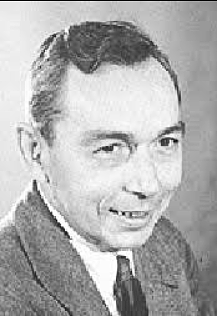
Marston Bates (1906–1974) was an American zoologist, ecologist and science writer. After conducting research on mosquitoes, malaria and yellow fever for the Rockefeller Foundation, he became Professor of Zoology at the University of Michigan. His later work increasingly focused on ecology, population and humanity’s relationship with the biosphere.
Humanity as a Disease of Nature
Marston Bates occupies an intermediate position in the intellectual history of the humanity–cancer analogy.
He did not originate the comparison between human population growth and malignant tumors. When he used the analogy explicitly, he correctly attributed it to Alan Gregg.
Nevertheless, Bates did more than merely repeat a striking phrase.
Across several writings in the early 1960s, he independently described human expansion as a pathological process within the biosphere and incorporated Gregg’s cancer analogy into his own ecological interpretation of humanity.
A Cancerous Multiplication
In The Forest and the Sea (1960), Bates identifies uncontrolled human population growth as one of the major long-term threats confronting humanity.
He describes the increase in human numbers as a “cancerous multiplication.”
He then moves immediately from demographic growth to a broader pathological interpretation.
As a component of nature, humanity appears to have become a disease of nature — perhaps even a fatal one.
The relationship is systemic.
Human beings remain dependent upon the natural system they are transforming, just as a pathogen remains dependent upon its host.
If the host is destroyed, the pathological agent cannot survive indefinitely either.
The Biosphere as the Larger System
This is the essential point of contact with Cancerism.
Human success cannot be evaluated solely from the perspective of human numbers, technological power or material expansion.
Homo sapiens exists within a larger biological system.
A process that appears successful from the perspective of the expanding population may simultaneously be destructive from the perspective of the biosphere that sustains it.
Bates therefore changes the scale from which human expansion must be judged.
The relevant system is not humanity alone, but humanity within the biosphere.
From Disease to Malignant Growth
In 1962 Bates made the pathological language even more explicit.
Writing about the future of biology, he described the human species as behaving like a disease of the biosphere — a wild malignant growth.
Rapid population increase, industrialization and urbanization were not isolated phenomena.
Together they represented an expanding human pressure upon the ecological system.
Bates therefore used the language of malignancy independently of any detailed cellular analogy.
His central concern remained ecological: one species was expanding in ways capable of damaging the larger living system upon which it depended.
Alan Gregg and the Cancer Analogy
When Bates explicitly compared humanity with cancer cells, however, he did not claim the analogy as his own.
In his 1962 Berkeley lecture “The Human Environment,” he credited Alan Gregg with observing that human population growth within the ecosystem was closely analogous to the growth of malignant tumor cells within an organism.
Bates accepted the comparison and developed one of its most important implications.
Cancer cells, if they could evaluate their own condition, might regard their rapid multiplication as evidence of extraordinary success.
But their success is illusory at the level of the organism.
When the organism dies, the cancer cells die with it.
Success from the Wrong Point of View
This reversal of perspective is Bates’s most interesting contribution to the analogy.
Numerical growth by itself does not demonstrate biological success.
A population can flourish locally while undermining the system necessary for its continued existence.
Human population growth can therefore appear successful when viewed from within humanity while appearing pathological when viewed from the level of the biosphere.
Cancer provides an especially powerful example because malignant cells display precisely this contradiction.
Their local reproductive success contributes to the destruction of the organism that makes their existence possible.
Humanity as an Evolutionary Problem
Bates also questioned the conventional assumption that human domination of the Earth necessarily represented evolutionary progress.
In another 1962 text, he suggested that from the perspective of the biosphere civilized humanity might appear less like the crowning achievement of evolution than an evolutionary mistake.
This idea approaches another important element of Cancerism.
Human biological success and technological superiority cannot automatically be equated with success for the larger living system.
The Human Transformation of Nature
Bates’s broader ecological analysis helps explain why he found the pathological analogy persuasive.
In “The Human Environment,” he reconstructs a long historical sequence in which human beings progressively transform their relationship with nature.
Tools and weapons increase human power.
The control of fire makes humanity an agent of ecological change.
Agriculture and domestication allow humans to reorganize plants, animals and landscapes.
Cities increase separation from direct ecological conditions.
Industrialization provides unprecedented access to energy and materials.
Modern science and technology greatly accelerate this process.
The result is a species that has moved from being one member of a biological community to becoming, in Bates’s words, something like a geological force capable of altering the planet.
The Enlarged Brain — but No Carcinogenesis
Bates also notes the exceptional enlargement of the human brain in comparison with other primates and emphasizes the enormous importance of culture, symbols and accumulated ideas.
This creates an interesting proximity to Cancerism.
Yet Bates does not make the causal connection that would be central to the later theory.
He does not identify the evolutionary transformation of the human brain as a carcinogenic event.
Nor does he derive humanity’s malignant ecological behavior systematically from cerebral evolution.
For Bates, human culture and ideas remain sufficiently flexible that better ideas might still redirect civilization.
A Hope Cancerism Does Not Share
This optimism marks an important difference.
Bates believes that because humans created their conceptual environment, they may also be able to change it.
Knowledge, ecological understanding and more rational choices might permit a better relationship with nature.
Cancerism is more skeptical.
If the mechanisms producing human expansion arise from deeply rooted evolutionary characteristics of Homo sapiens, cultural correction alone may not be sufficient to reverse the process.
Why Bates Belongs among the Precursors
Bates should not be placed in the same category as Alan Gregg, Warren Hern, Frank Forencich or other thinkers who independently developed a detailed oncological model.
His importance is more limited but still significant.
Before explicitly adopting Gregg’s cancer analogy, Bates had already described uncontrolled human population increase as a “cancerous multiplication” and humanity as a possible disease of nature.
He subsequently described the human species as a malignant growth of the biosphere and repeatedly accepted Gregg’s comparison between human expansion and cancer-cell proliferation.
Bates therefore belongs among the precursors not as an originator of the humanity–cancer model, but as an early ecologist who accepted, reinforced and integrated that model into a broader interpretation of humanity’s pathological relationship with the biosphere.
KEY AFFINITIES WITH CANCERISM
- Human population growth described as “cancerous multiplication”
- Humanity described as a disease of nature and of the biosphere
- The biosphere understood as the larger system upon which humanity depends
- Recognition that destruction of the host system ultimately destroys the pathological agent
- Explicit acceptance of Alan Gregg’s comparison between human population growth and malignant tumor growth
- Recognition that rapid proliferation may appear successful from the perspective of the proliferating population while being disastrous for the larger system
- Human expansion linked with industrialization, urbanization and ecological transformation
- Homo sapiens understood as having become a planetary-scale force
- Conventional interpretations of human evolutionary “success” called into question
- Exceptional enlargement of the human brain and the power of culture explicitly recognized
POINT OF DIVERGENCE
- Bates did not originate the cancer analogy and never developed it into a systematic theory of planetary malignancy. Above all, he did not identify the abnormal evolutionary development of the human brain as the carcinogenic transformation that generated the human process. He regarded culture and ideas as major causes of humanity’s ecological behavior and retained confidence that better knowledge and better ideas might redirect it. Cancerism instead locates the deepest origin of the malignancy in biological evolution itself.
Sources
Marston Bates, The Forest and the Sea: A Look at the Economy of Nature and the Ecology of Man, Random House, New York, 1960.
Marston Bates, “Biology for the Future Citizen and the Future Biologist,” 1962.
Marston Bates, “The Human Environment,” Horace M. Albright Lecture in Conservation, University of California, Berkeley, 23 April 1962.
Marston Bates, interview in Charles F. Madden (ed.), Talks with Social Scientists, Southern Illinois University Press, 1968; interview conducted 5 March 1964.
Alan Gregg, “A Medical Aspect of the Population Problem,” Science, vol. 121, no. 3150, 13 May 1955, pp. 681–682.
