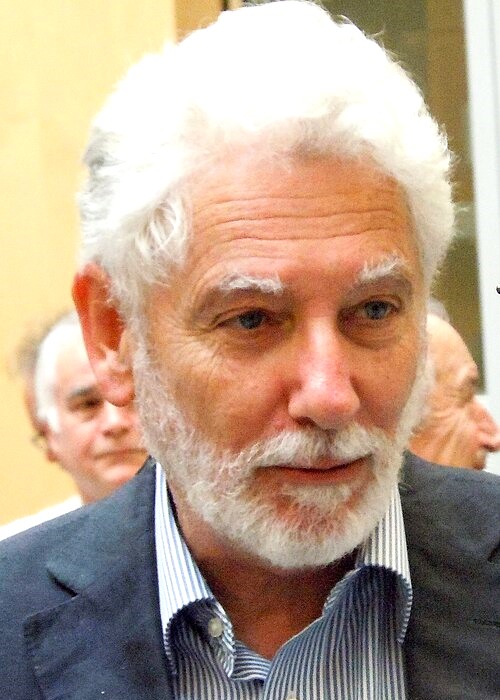
Philippe Descola (born 1949) is a French anthropologist and professor emeritus at the Collège de France. A former student of Claude Lévi-Strauss, he carried out extensive fieldwork among the Achuar of the Ecuadorian Amazon and developed a comparative anthropology examining the different ways societies construct relationships between humans and non-humans.
We Have Become Viruses for the Planet
In May 2020, during the first phase of the Covid-19 pandemic, Philippe Descola gave an interview to Le Monde under a striking title: “Nous sommes devenus des virus pour la planète” — “We Have Become Viruses for the Planet.”
The biological image differs from the cancer model, but the underlying diagnosis converges with several central elements of Cancerism.
Human societies have progressively transformed their relationship with the biosphere until one component of the living system has begun to undermine the conditions upon which the entire system — including itself — depends.
The Pandemic as a Revealing Event
For Descola, Covid-19 was not an isolated biological accident.
He interpreted the pandemic as a revealing event: a crisis capable of exposing structural characteristics of contemporary civilization.
The destruction and contraction of relatively undisturbed environments, industrial agriculture, extensive livestock farming, mineral and fossil-fuel extraction and the increasing penetration of human activity into wild habitats bring humans into closer contact with species carrying pathogens.
Zoonotic disease therefore cannot be completely separated from ecological disruption.
The health crisis reveals the ecological structure of the society that produced the conditions in which it emerged.
The Virus and Its Host
Asked why modern capitalism could be compared with a virus, Descola defines the essential relationship very simply.
A virus is a parasite that replicates at the expense of its host and may eventually kill it.
He then applies this structure to capitalism’s relationship with the Earth.
Since the Industrial Revolution, the economic system has expanded by consuming and transforming the ecological conditions that sustain it.
For a long time this occurred without full awareness of the consequences.
Today, Descola argues, humanity knows what is happening but remains reluctant to make the changes in ways of life that would be required.
From Capitalism to “We”
The argument begins with capitalism, but Descola’s formulation eventually becomes broader.
Capitalism originated in Europe, he observes, but it cannot be defined ethnically.
Its logic has spread across the planet.
It propagates almost like an epidemic, destroying not necessarily its practitioners directly but the long-term conditions of life for all Earth’s inhabitants.
It is in this context that Descola reaches his striking conclusion:
“We have become viruses for the planet.”
The shift from “capitalism” to “we” is significant.
The pathological relationship is no longer described solely as an abstract economic mechanism. It has become embodied in a global human civilization organized around appropriation, expansion and exploitation.
The Separation of Humanity from Nature
Descola then moves to a deeper cultural problem.
Beginning around the seventeenth century, he argues, Europe developed what he calls a “naturalist” worldview.
Humans increasingly imagined themselves as occupying a world separate from that of non-humans.
Everything outside humanity could consequently be grouped under the concept of “nature.”
Nature could be studied scientifically.
It could become a reservoir of resources.
And it could be appropriated and transformed for human purposes.
A Mental Revolution
This transformation was not merely technological or economic.
It was also conceptual.
Descola describes the separation between humans and non-humans as a mental revolution that simultaneously contributed to extraordinary scientific knowledge and to the conditions that made intensive exploitation possible.
Once nature was conceived as an external domain, humanity could increasingly behave as though it stood outside the ecological system of which it was actually a part.
This is one of the strongest points of contact with Cancerism.
The malignant human process depends precisely upon the extraordinary capacity of Homo sapiens to act as though the constraints governing other forms of life no longer fully applied to itself.
There Is No World Outside the Living System
Descola insists that this separation is an illusion.
The chain of life is composed of interdependent relationships from which humans cannot withdraw.
The distinction between an autonomous human “us” and an external natural “them” becomes increasingly difficult to sustain when the human body itself contains immense communities of microorganisms and when actions such as emitting carbon dioxide alter planetary processes extending far beyond the individual.
Human beings cannot retreat into an independent sphere.
They remain embedded within the system they transform.
Human Exceptionalism
Descola’s anthropology therefore challenges several centuries of human exceptionalism.
Western thought has frequently treated non-human beings as passive surroundings for the human drama.
Descola instead proposes an anthropology in which non-humans become participants in networks of relationships rather than merely objects, resources or scenery.
This conceptual shift is important for Cancerism because malignant behaviour depends upon an extreme asymmetry: one component of the biosphere progressively subordinates the others to its own requirements.
The Appropriation of the Living World
Descola contrasts the modern process of appropriation with societies whose relationships with their environments are organized differently.
The contemporary global system privileges competition, private appropriation and intensive exploitation.
Alternative relationships can emphasize interdependence, territorial attachment, care for other beings and respect for ecological rhythms.
This demonstrates, for Descola, that the present relationship between humanity and the biosphere is not the only conceivable cultural arrangement.
A Politics of the Earth
His proposed response is therefore political as well as intellectual.
Descola calls for a “politics of the Earth” in which the planet is understood as a common home whose use cannot be reserved exclusively for humans.
Non-human entities and environments must acquire forms of representation.
Mountains, watersheds, territories and other living systems can be recognized as possessing interests that human political institutions should take into account.
This represents a direct challenge to anthropocentric politics.
Where Descola and Cancerism Converge
The convergence is substantial.
Both reject the idea that humanity exists independently from the biosphere.
Both emphasize the interdependence of living systems.
Both describe modern human activity as progressively destroying the conditions that sustain life.
Both identify technological, economic and cultural expansion as mechanisms through which humans appropriate increasing portions of the natural world.
Both question human exceptionalism.
And both use pathological biological imagery to describe a process in which one component expands at the expense of the larger system upon which it depends.
Where the Causal Explanations Separate
The principal difference concerns causation.
Descola locates a decisive transformation in the emergence of the Western naturalist worldview, modern capitalism and the separation of humanity from nature that developed particularly from the seventeenth century onward.
Cancerism regards these phenomena as much later manifestations of a process whose origin lies far deeper in evolutionary history.
The ability to conceive nature as an external object, construct economic systems, develop science and technology and reorganize entire ecosystems was made possible by the exceptional development of the human brain long before capitalism appeared.
From the Cancerist perspective, capitalism can enormously accelerate the malignant process, but it cannot constitute its ultimate cause.
Not All Human Cultures Are Equivalent
A second difference follows from Descola’s anthropological work.
He emphasizes that human societies have conceived and organized relations with non-human beings in very different ways.
Indigenous societies may maintain forms of ecological relationship radically different from the Western naturalist model.
Cancerism can recognize these important differences in intensity, organization and environmental impact while nevertheless locating the fundamental anomaly at the level of the species.
Different cultures can restrain or accelerate the process.
They do not alter the evolutionary origin of the cognitive capacity that makes human ecological transcendence possible.
Virus or Cancer?
Descola’s image of humanity as a virus captures an important aspect of the planetary crisis: a replicating process expands at the expense of the system that sustains it and may eventually destroy the conditions necessary for its own survival.
Cancerism, however, considers malignant cancer cells a more precise biological model.
A virus is a distinct biological entity that enters and exploits a host. A cancer cell, by contrast, originates within the organism itself. It was once a normal component of the larger living system before undergoing changes that caused it to escape the regulatory mechanisms governing healthy cellular life.
Humanity likewise did not invade the biosphere from outside.
Homo sapiens arose within it through the same evolutionary processes that produced every other species.
The Cancerist question is therefore not simply how humanity came to exploit the Earth, but how one component of the biosphere acquired characteristics that allowed it progressively to escape the ecological constraints regulating the other components.
From Carcinogenesis to Hominization
This distinction leads to the deepest difference between the viral image and the Cancerist model.
Cancer begins with carcinogenesis: a transformation of previously normal cells that alters their behaviour and allows uncontrolled proliferation.
Cancerism proposes an analogous question about human evolution.
At a certain stage of hominization, genetic and evolutionary changes made possible the exceptional expansion and reorganization of the human brain. The resulting cognitive capacities allowed Homo sapiens increasingly to oppose instinctive and ecological constraints, construct artificial environments and transform surrounding nature according to its own requirements.
From the Cancerist perspective, this evolutionary transformation represents the remote origin of the planetary malignant process.
The later development of agriculture, cities, technology, industrialization and global economic systems constitutes successive stages of its expansion rather than its primary cause.
Four Characteristics of Malignant Expansion
The cancer model also permits a more detailed structural comparison.
Cancerism identifies four major characteristics of malignant disease that find striking parallels in human expansion:
- rapid and insufficiently regulated proliferation
- invasion and destruction of surrounding healthy tissues
- progressive de-differentiation and homogenization
- spread into increasingly distant regions — metastasis
Human demographic expansion, ecological destruction, global cultural homogenization and the occupation of virtually every terrestrial environment can therefore be interpreted as successive manifestations of the same underlying process.
Descola’s viral metaphor captures replication and damage to the host.
The cancer model attempts to explain not only expansion but also the transformation that made such expansion possible.
Why Descola Is a Parallel Thinker of Cancerism
Descola cannot be described as a precursor in the strict chronological sense, since this formulation appeared in 2020, after the first formulation of Cancerism.
He belongs instead among its parallel thinkers.
Working independently from a different anthropological tradition, he arrived at a diagnosis with striking affinities to the Cancerist framework.
Humans cannot exist outside the living system.
Yet modern civilization behaves increasingly as if nature were an external reservoir available for unlimited appropriation.
The system expands at the expense of the conditions that sustain it.
The distinction between humanity and the rest of nature becomes both intellectually false and ecologically destructive.
And the result can legitimately be described through the language of biological pathology.
KEY AFFINITIES WITH CANCERISM
- Humanity understood as inseparable from the larger living system
- Ecological interdependence opposed to human exceptionalism
- Human expansion destroying the conditions upon which human life itself depends
- Pathological biological imagery used to describe civilization’s relationship with the planet
- Expansion and replication at the expense of the sustaining system
- Intensive exploitation of living systems and natural resources
- Globalization spreading destructive practices across the planet
- Critique of the illusion that humans can place themselves outside ecological constraints
- Recognition that conceptual and technological developments can intensify environmental domination
- Rejection of a political order designed exclusively around human interests
- The Earth understood as a common system shared with non-human beings
POINT OF DIVERGENCE
POINT OF DIVERGENCE
- Descola locates the decisive causes of the present planetary crisis primarily in the Western naturalist separation between humans and non-humans, capitalism and the historical forms of appropriation that intensified from the modern era onward. Cancerism regards these as relatively recent manifestations of a much older process. It locates the primary carcinogenic transformation in human biological evolution itself: the development of an exceptional brain that enabled Homo sapiens progressively to escape ecological constraints and construct artificial systems increasingly independent of natural regulation.
- Descola uses the virus as his biological image. Cancerism considers the malignant cell a more precise model because humanity, like cancer, arose from within the living system it now damages. The comparison also extends beyond replication to carcinogenesis, uncontrolled proliferation, invasion, de-differentiation and metastasis.
Source
Philippe Descola, interview by Nicolas Truong, “Nous sommes devenus des virus pour la planète,” Le Monde, 20 May 2020.
English translations and paraphrases on this page have been prepared from the original French interview.
