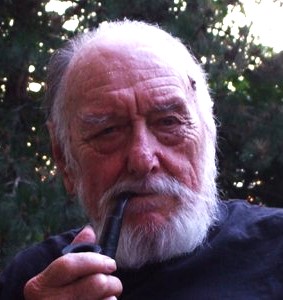
Rutilio Sermonti (1921–2015) was an Italian zoologist, natural-history writer, artist and essayist. Deeply interested in animals and the natural world, he produced both scientific and popular writings and was active in environmental circles, while also developing strongly critical views of conventional evolutionary theory.
The Earth Is Dying of Cancer
Rutilio Sermonti’s 2012 essay “La Terra muore di cancro” (“The Earth Is Dying of Cancer”) is one of the most explicit formulations of the humanity–cancer analogy found among the precursors of Cancerism.
Sermonti does not present the comparison as a literary image.
He states that Earth is suffering from cancer and identifies the carcinoma by name: Homo sapiens.
For him, this is not merely a metaphor but a diagnosis.
A Precise Diagnosis
Sermonti begins from the biological behaviour of malignant cells.
Cancer arises when a population of cells abandons the cooperation and regulation characteristic of healthy tissue, begins to grow abnormally and eventually destroys both surrounding tissues and the organism that sustains it.
He then transfers this model directly to the biosphere.
If Earth and its living systems are understood as an organic whole composed of interdependent species, humanity appears as the component that has broken away from that equilibrium.
Homo sapiens becomes the malignant population within the larger living system.
False Needs and Unlimited Predation
One of Sermonti’s strongest points concerns human needs.
Unlike other species, he argues, humanity continually creates new and artificial requirements.
These expanding demands produce levels of predation far beyond immediate biological necessity.
Resources are extracted not simply to survive but to sustain ever more elaborate systems of production, consumption and technological convenience.
The result is an escalating appropriation of both living and non-living components of the planet.
Waste as a Product of the Malignant Process
Sermonti also emphasizes another uniquely human feature: waste.
Human civilization generates enormous quantities of materials that cannot be reintegrated harmlessly into natural cycles.
Many are persistent, toxic or directly lethal.
The malignant process therefore damages the surrounding system not only through resource consumption but also through the products it releases.
Human metabolism at the civilizational scale becomes incompatible with the ecological systems upon which it depends.
From Tumor to Metastasis
Sermonti develops the analogy further through metastasis.
A malignant tumor becomes especially dangerous when cells detach from the primary lesion and establish new proliferating centers elsewhere in the organism.
He sees an analogous process at the planetary level.
Pollutants and destructive technologies spread through rivers, soils, atmosphere and global networks.
The pathological process is no longer localized.
It becomes planetary.
The Metastasis of Ideas
Sermonti adds an unusual element to the analogy: mental transmission.
The human mind, he argues, allows destructive patterns of behaviour to spread far beyond their original geographical location.
Ideas, values and models of “progress” can be transmitted across populations much faster than biological organisms could spread by ordinary migration alone.
Thus, for Sermonti, human malignancy possesses not only material but also cultural and mental mechanisms of metastasis.
This is one of the most striking elements of his essay.
The Mind in the Service of the Disease
Sermonti writes that humanity has placed its distinctive mental capacity at the service of the destruction of the Earth.
This brings him close to one of the central questions of Cancerism.
Yet the similarity is incomplete.
For Sermonti, the mind is primarily an instrument later placed at the service of an already existing destructive process.
Cancerism reverses the causal relationship.
It regards the abnormal evolutionary development of the human brain as the very event that made the malignant process possible in the first place.
Where Sermonti Places the Beginning
The most important divergence concerns the historical origin of the disease.
Sermonti explicitly rejects the idea that humanity’s betrayal of nature began at the origins of Homo sapiens.
He locates the decisive rupture much later, approximately in the eighteenth century, linking it to the Enlightenment, modern ideologies and the subsequent development of industrial civilization.
He therefore interprets the malignant transformation primarily as a recent historical and ideological event.
Cancerism locates the carcinogenesis much deeper in evolutionary time.
Industrial civilization represents an immense acceleration of the disease, but not its origin.
Agriculture, deforestation, urbanization, territorial expansion and the progressive domination of other species were already manifestations of the process long before the eighteenth century.
A Political Interpretation of the Disease
Sermonti’s political interpretation creates an even sharper divergence.
His lifelong fascist commitments strongly influenced the final part of the essay. During the Second World War, he served in the Italian Social Republic, the fascist state established by Benito Mussolini in order to continue the war alongside Nazi Germany. After the war, he remained associated with the Italian neo-fascist political movement and continued to defend his political past.
In “The Earth Is Dying of Cancer,” this background becomes part of his explanation of planetary malignancy.
He portrays the political forces associated with Fascism and the Axis as having represented, at least in part, an attempted resistance to the process he condemns.
This interpretation is not part of Cancerism.
Cancerism does not identify the malignant process with a political party, ideology, nation, race or historical coalition.
The pathology is biological and species-wide.
Political systems may accelerate, channel or temporarily modify its manifestations, but none lies outside the underlying human process.
The Disease Is Homo sapiens
This distinction is particularly important because Sermonti’s own opening diagnosis is much broader than his later political explanation.
At the beginning of the essay, the cancer is Homo sapiens.
That formulation is structurally close to Cancerism.
Later, however, he progressively narrows responsibility toward specific historical, ideological and political actors.
The two levels do not fully coincide.
If the malignant agent is the species itself, its origin cannot ultimately be explained by a political development occurring only a few centuries ago.
An Episodic but Remarkable Formulation
There is no evidence, so far, that Sermonti developed this idea into a larger systematic theory across multiple works.
“The Earth Is Dying of Cancer” appears to be an isolated but unusually complete formulation.
This makes his case comparable in one respect to Cioran’s: a powerful intuition appears without becoming the organizing principle of an extensive body of work.
The difference is that Sermonti’s single essay develops the cancer analogy far more systematically than Cioran’s aphorisms.
Where Sermonti and Cancerism Converge
The convergence is nevertheless extraordinary.
Sermonti explicitly identifies Homo sapiens as the cancer of the Earth.
He interprets the biosphere as an integrated living system.
He compares abnormal human growth with malignant cellular proliferation.
He describes excessive resource appropriation, toxic waste, destruction of other forms of life and planetary metastasis.
He recognizes that the malignant process ultimately destroys both the host and itself.
And he identifies the human mind as deeply implicated in the spread of the disease.
Few texts state the structural analogy so directly.
Where Sermonti and Cancerism Diverge
The disagreement concerns not primarily the diagnosis but the etiology.
Sermonti locates the decisive rupture in recent cultural and political history.
Cancerism locates it in the evolutionary history of Homo sapiens.
Sermonti treats the mind largely as an instrument exploited by the malignant process.
Cancerism regards the abnormal development of the brain as the origin of that process.
And Sermonti introduces a political interpretation in which particular modern ideologies and historical forces carry special responsibility.
Cancerism instead treats malignancy as a property of the species that transcends political divisions.
Why Sermonti Belongs among the Precursors
Sermonti belongs among the most explicit precursors of Cancerism because his 2012 essay contains an exceptionally clear statement of the central analogy.
The Earth is the larger living system.
Homo sapiens is the malignant component.
Human proliferation breaks ecological regulation.
Human consumption appropriates excessive resources.
Human civilization produces toxic metabolic waste.
The process spreads through material and mental networks.
Metastasis becomes planetary.
And continued expansion threatens both the biosphere and humanity itself.
The explanatory framework differs sharply from Cancerism in important respects, but the diagnosis itself is remarkably close.
KEY AFFINITIES WITH CANCERISM
- Homo sapiens explicitly identified as the cancer of the Earth
- The cancer comparison presented as a diagnosis rather than a rhetorical metaphor
- The biosphere understood as an integrated living system
- Abnormal human expansion compared with malignant cellular growth
- Excessive appropriation of resources
- Production of toxic and non-recyclable waste
- Destruction of other species and ecological equilibrium
- Planetary diffusion interpreted through the concept of metastasis
- Mental and cultural transmission contributing to the spread of the malignant process
- Recognition that destruction of the host ultimately threatens the malignant population itself
- The human mind recognized as deeply implicated in the planetary pathology
POINT OF DIVERGENCE
- Sermonti locates the decisive origin of the planetary disease largely in the Enlightenment, modern ideology and recent political history, and interprets twentieth-century conflicts through his own enduring fascist commitments. Cancerism rejects a political or ideological origin of the malignancy and locates carcinogenesis much earlier, in the abnormal evolutionary development of the human brain. Political systems are manifestations of a species-wide biological process, not its ultimate cause.
Source
Rutilio Sermonti, “La Terra muore di cancro” (“The Earth Is Dying of Cancer”), 2012. Originally published on the Ipharra blog and later reproduced by Centro Studi Aurhelio.
