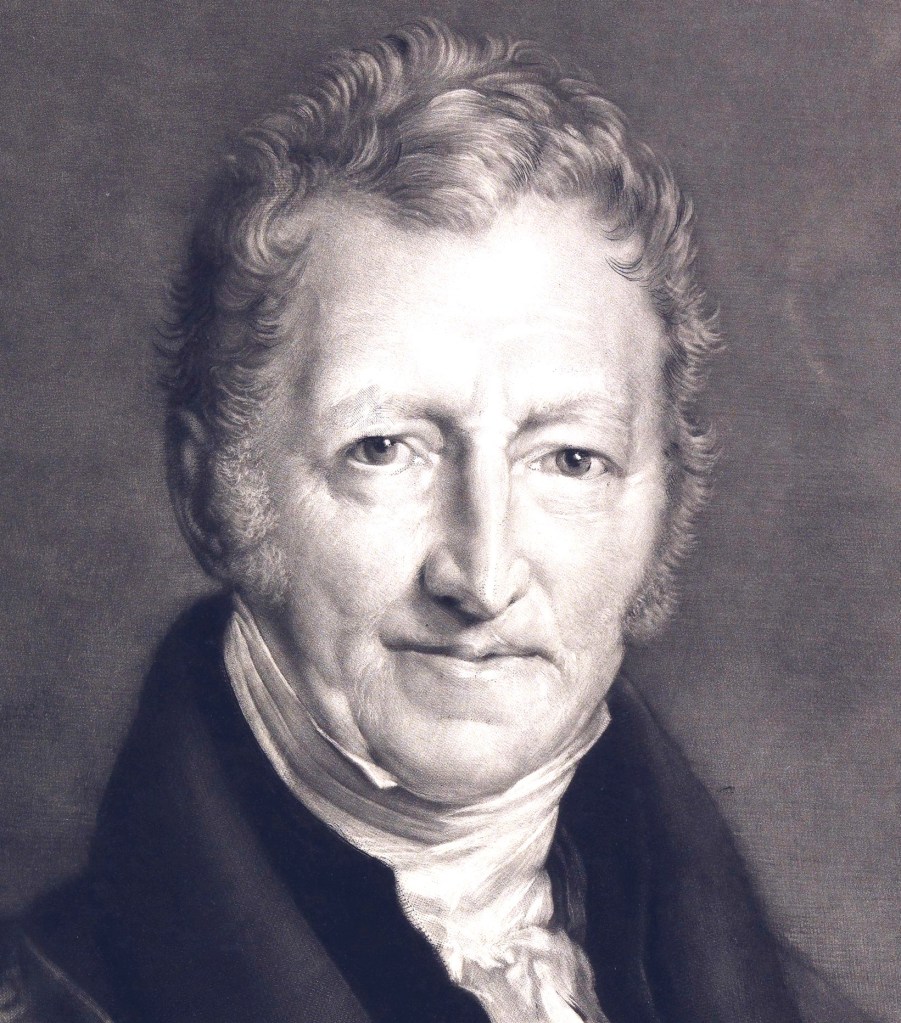
Thomas Robert Malthus (1766–1834) was an English economist, cleric and scholar best known for his theory of population. In An Essay on the Principle of Population (1798), he argued that population tends to grow faster than the resources needed to sustain it, so growth is ultimately constrained by famine, disease, war and other checks. His work became foundational in demography, economics and later evolutionary thought, influencing, among others, Charles Darwin and Alfred Russel Wallace.
Population and the Limits of Growth
Thomas Robert Malthus belongs among the early precursors of Cancerism because he identified one of the fundamental dynamics that later becomes central to the theory: population cannot expand indefinitely within a finite system of resources.
In An Essay on the Principle of Population, first published anonymously in 1798, Malthus argued that population possesses a tendency to increase more rapidly than the means of subsistence available to sustain it.
His argument was not ecological in the modern sense, and it was not oncological.
But it established a principle that remains fundamental to any theory of uncontrolled biological expansion.
Population When Unchecked
Malthus formulated the problem in stark terms.
Population, when not restrained, tends to increase geometrically.
Subsistence, he argued, can increase only much more slowly.
The consequence is unavoidable: population repeatedly presses against the limits imposed by available resources.
This is the first important point of contact with Cancerism.
A proliferating biological population cannot be understood independently of the larger system that supplies the resources necessary for its continued existence.
The Necessity of Checks
For Malthus, indefinite population growth is impossible.
Some form of restraint must eventually intervene.
He distinguished between preventive checks, which reduce the rate of reproduction, and positive checks, which increase mortality after population has already begun to exceed the available means of support.
Among the latter he included famine, disease, war and other forms of misery.
The basic principle is systemic:
growth generates pressure;
pressure encounters limits;
limits eventually restrain growth.
Nature Regulates Population
This structure is important for Cancerism because natural populations normally exist within networks of ecological regulation.
Food availability, disease, competition, predation and other environmental pressures prevent unlimited expansion.
Malthus did not possess the later concepts of ecology, carrying capacity or ecosystem regulation in their modern scientific form.
Yet his population principle already described a world in which biological growth is necessarily constrained by material conditions.
The Human Exception
The decisive question for Cancerism begins where Malthus largely stops.
What happens when one species becomes progressively capable of postponing, weakening or overcoming those restraints?
Agriculture expands food production.
Technology increases access to resources.
Medicine reduces mortality.
Sanitation limits disease.
Transportation moves resources over enormous distances.
Artificial environments protect humans from climatic and ecological pressures.
Each of these developments can temporarily weaken one of the checks that would otherwise constrain population.
Escaping the Malthusian Checks
From a Cancerist perspective, the extraordinary history of Homo sapiens can therefore be read partly as a progressive escape from the checks described by Malthus.
The checks do not disappear.
They are displaced.
Technology allows human populations to postpone scarcity, reduce mortality and increase the carrying capacity available to themselves.
But every successful postponement can also permit further demographic and economic expansion.
The result is a feedback process in which the capacity to escape limits becomes itself a mechanism of further growth.
Intelligence as Restraint — or as Escape
Here an important difference emerges.
Malthus regarded human reason as potentially capable of exercising restraint.
Unlike other animals, human beings can anticipate future difficulties and modify reproductive behaviour before famine or mortality impose limits.
Cancerism emphasizes another side of the same faculty.
Human intelligence has indeed made foresight possible.
But it has also enabled Homo sapiens to alter environments, create new resources, neutralize natural constraints and postpone the consequences of overexpansion.
The brain that can recognize limits is also the brain that has repeatedly learned how to circumvent them.
From Population Pressure to Planetary Expansion
Malthus concentrated primarily on the relationship between population and subsistence.
Cancerism expands the analysis.
Human proliferation does not affect food supply alone.
It requires land, energy, minerals, water, forests, infrastructure and increasingly complex technological systems.
As human numbers and consumption increase, other components of the biosphere are displaced, transformed or destroyed.
Population pressure therefore becomes one component of a much broader malignant process.
Where Malthus and Cancerism Converge
The convergence lies in the logic of limits.
Both recognize that unlimited proliferation is incompatible with a finite supporting system.
Both assume that growth must eventually encounter mechanisms of restraint.
Both treat population dynamics as inseparable from the resources required to sustain them.
And both reject the idea that continued expansion can proceed indefinitely without consequences.
Where the Explanations Separate
Malthus does not describe humanity as a disease of the biosphere.
He does not compare human beings with malignant cells.
He does not analyze invasion, metastasis, de-differentiation or destruction of surrounding biological tissues.
Nor does he identify the evolutionary development of the human brain as the event that enabled Homo sapiens progressively to escape natural regulation.
His concern is primarily demographic and economic: the tension between population and subsistence.
Cancerism incorporates that tension into a much larger biological and ecological theory.
Why Malthus Belongs among the Precursors
Malthus belongs among the early precursors of Cancerism because he identified one of the basic laws underlying any process of uncontrolled proliferation.
Growth cannot be separated from limits.
A population dependent upon finite resources cannot increase indefinitely.
When growth exceeds the capacity of the supporting system, mechanisms of restraint necessarily intervene.
Cancerism takes this principle further by asking why Homo sapiens became uniquely capable of postponing those restraints and transforming the environment in order to sustain further expansion.
The Malthusian problem is therefore not the Cancerist diagnosis.
It is one of its earliest intellectual foundations.
KEY AFFINITIES WITH CANCERISM
- Recognition that population possesses a strong tendency toward expansion
- Unlimited growth understood as impossible within finite material conditions
- Population growth linked directly to resource availability
- Natural limits understood as necessary restraints upon biological proliferation
- Disease, famine and mortality recognized as mechanisms capable of reducing excessive population growth
- Human populations subject to the same basic material constraints as other biological populations
- A systemic relationship between proliferation, resources and crisis
- The possibility of deliberate human restraint through foresight
POINT OF DIVERGENCE
- Malthus analyzes the tension between population and subsistence but does not interpret humanity as a pathological component of the biosphere. He does not develop a cancer analogy and does not ask how human biological evolution produced a species capable of progressively evading natural checks. Cancerism identifies the abnormal evolutionary development of the human brain as the primary transformation that enabled Homo sapiens to overcome ecological constraints, expand its carrying capacity and convert a demographic problem into a planetary malignant process.
Source
Thomas Robert Malthus, An Essay on the Principle of Population, as It Affects the Future Improvement of Society, London, 1798.
